Finding someone online is easy. Knowing whether you can trust them is much harder.
Today, most digital platforms begin with the same basic idea: create a profile, add information, and make yourself discoverable. That model works well for search. But when the outcome actually matters, a profile often isn't enough.
You may be looking for a mentor, a job opportunity, a business partner, or a professional you can confidently recommend. In each case, one question naturally follows:
How am I connected to this person, and why should I trust them?
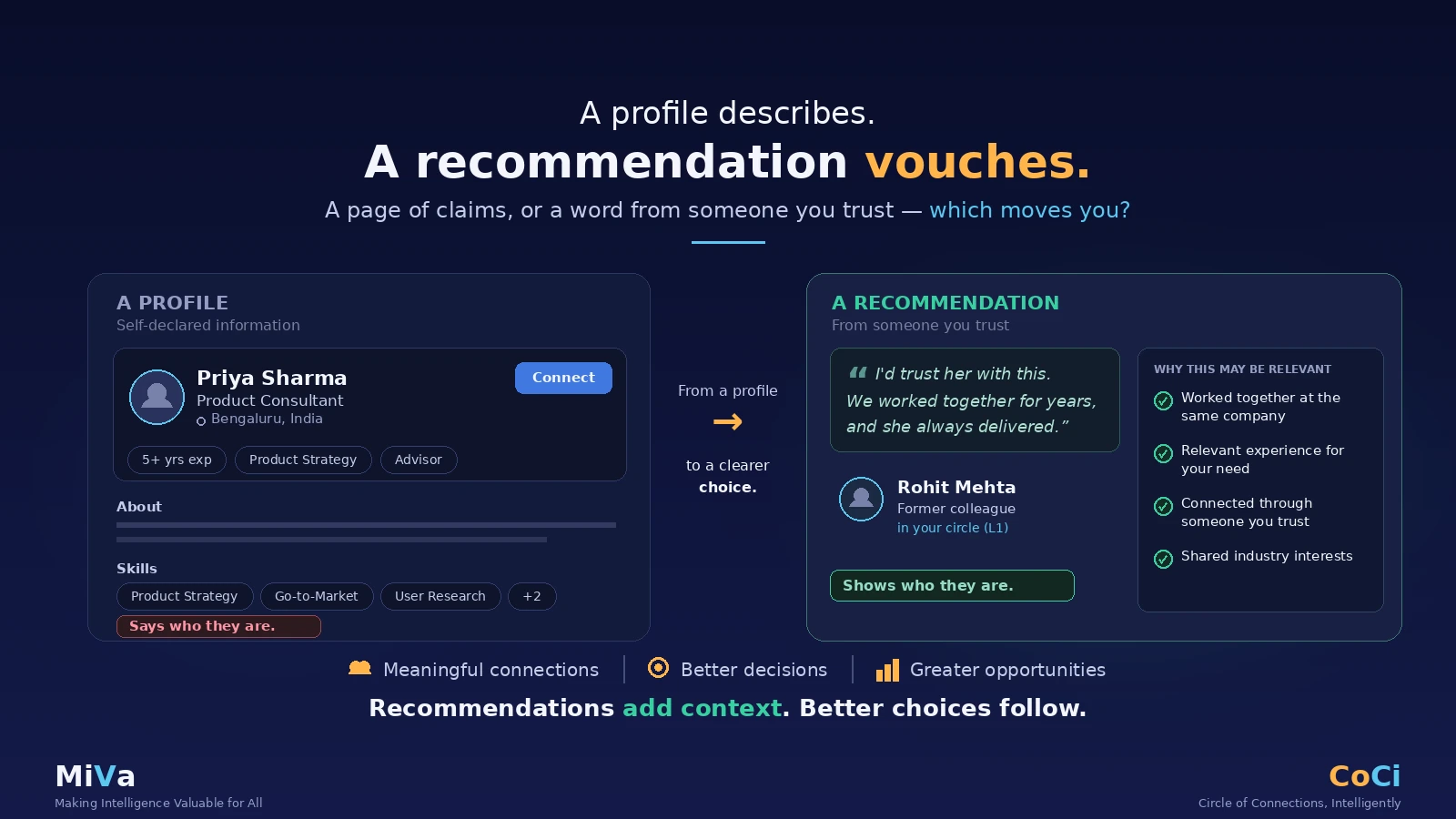
A profile can describe a person. It cannot tell the whole story.
A profile can show experience, qualifications, interests, photographs, companies, skills, and other information. These details are useful, but they are still only part of the picture.
Think about how trust works in the real world.
A friend says, “I know someone who can help you.”
A former colleague introduces you to a specialist.
A mentor recommends someone they have worked with.
A business owner asks another business owner, “Do you know someone reliable for this?”
In those moments, the value is not just the person's profile. It is the relationship and context behind the introduction.
Someone may be highly qualified, but the fact that a person you already trust knows them can give you a completely different level of confidence.
The missing layer is often the path
Most digital systems are very good at answering:
“Who matches this search?”
But people often need an additional answer:
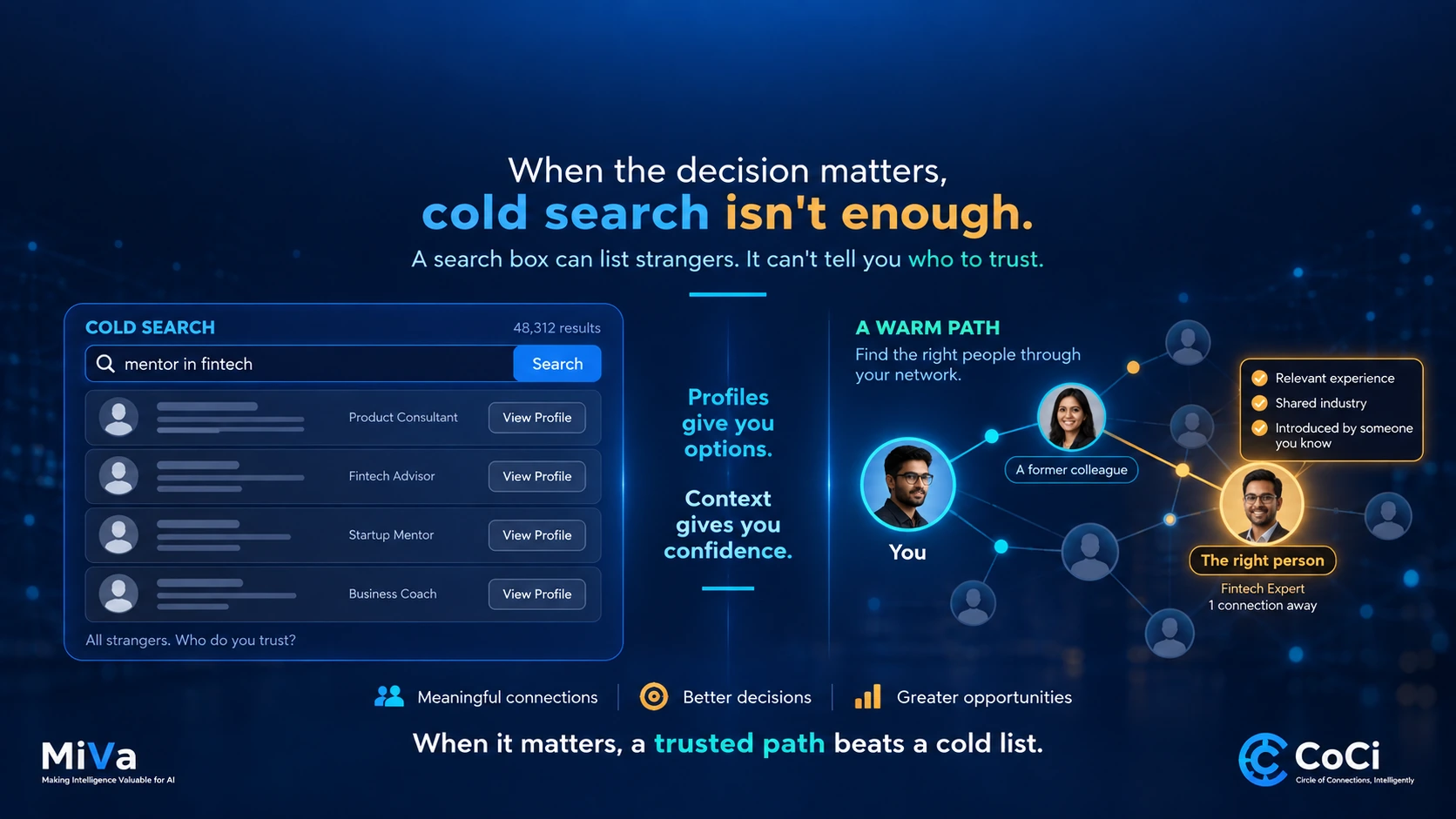
“How did I get to this person?”
That path might be direct. It might pass through a colleague. It might come through a friend of a friend. It might connect through a professional community or another meaningful relationship.
That relationship context can change how we evaluate an introduction.
This is one of the ideas behind CoCi.
Instead of treating every person as an isolated profile, CoCi is being built around a Circle of Connections — a structured view of relationships that can help make the path between people more visible.
Connections are not all equal
Your contact list is not the same thing as your trusted network.
You may know hundreds of people, but only a smaller group may be people whose judgment, experience, or recommendation you genuinely value.
And those people may themselves know others who could be relevant to you.
That creates layers of relationships.
Your direct connections form one layer. People connected through them form another. Beyond that, your network can extend further.
The important idea is not simply counting how many connections exist.
It is understanding which connections matter, how they relate to one another, and what context they can provide.
Why trust is becoming a digital product problem
The internet made it incredibly easy to create and distribute information.
It also made it incredibly easy to create profiles.
That creates a growing gap between identity and trust.
A person can present credentials. A business can publish a website. A professional can create a polished profile. An online account can look convincing.
But credibility is not created simply because information exists.
Trust is built through evidence, relationships, consistency, context, and experience.
That is why the next generation of digital platforms may need to think beyond static profiles and toward more dynamic forms of identity and trust.
CoCi is being developed around that direction: starting with real relationships and allowing trust signals and identity context to evolve over time.
Trust should not become another mysterious score
There is an obvious temptation in digital systems to reduce trust to one number.
But human trust rarely works that way.
When someone recommends a person to you, you naturally consider things like:
Who recommended them?
How well does that person know them?
What kind of relationship do they have?
Have other people had positive experiences with them?
Is there relevant verification or evidence?
Is the connection recent and meaningful, or is it simply a name sitting in an old contact list?
The context matters.
That is why CoCi's trust direction is not simply about producing a number. It is about making useful trust signals and relationship context more understandable.
Where AI fits into the picture
AI can make this relationship-based model much more useful.
Imagine telling CoCi:
“I need someone who can help me understand how to enter this industry.”
Or:
“I am looking for a reliable professional for this service.”
Instead of forcing you to search through endless profiles, an intelligent system can help interpret what you need, identify potentially relevant people, and surface the relationship path that connects you to them.
That is where AI can become an interface to your network rather than a replacement for human relationships.
The technology can help discover the path.
The people still create the trust.
From search results to meaningful introductions
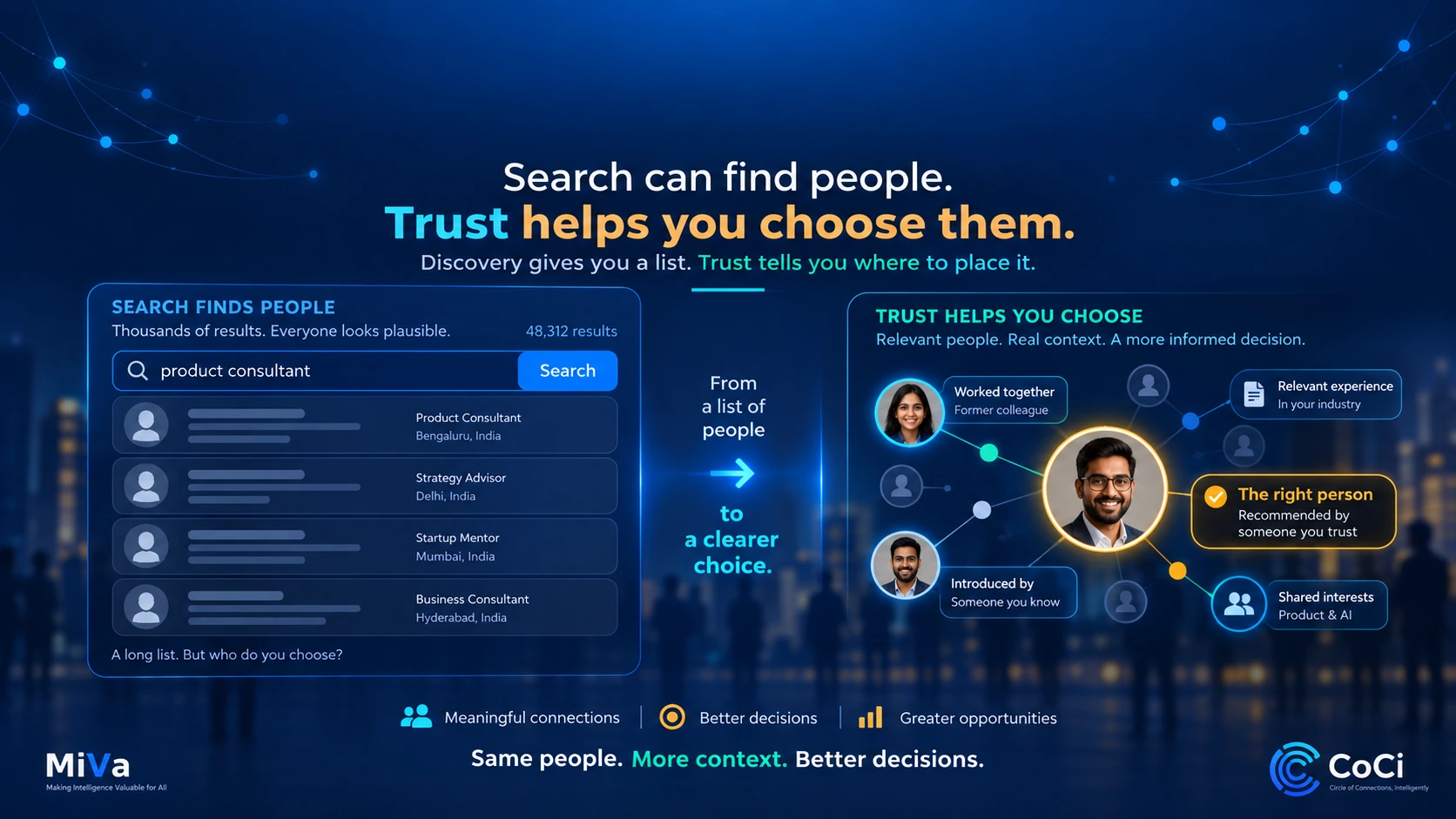
There is a subtle but important difference between finding a person and finding the right person.
Search can give you possibilities.
Profiles can give you information.
Recommendations can give you context.
Relationships can give you confidence.
CoCi is exploring what happens when these ideas are brought together in one experience.
The goal is not to create another place where people collect contacts.
The goal is to make the human network around them more visible, understandable, and useful.
Where CoCi is starting
CoCi is initially focused on areas where trusted relationships can make a meaningful difference:
Mentorship. Finding someone whose experience can help you take the next step.
Career & Jobs. Discovering people and opportunities through relevant relationships rather than relying only on cold search.
Business & Professional Services. Finding people who may be relevant to a business need while seeing the relationship context around them.
These are only starting points. The larger idea is much broader: helping people interact digitally with greater confidence because trust is connected to real human relationships.
A different way to think about your digital identity
Your digital identity should not have to be a collection of isolated profiles scattered across different platforms.
It can be richer than a bio.
It can include relationships, context, recommendations, verification signals, experiences, and reputation that evolve over time.
This is the direction CoCi is exploring — a more human approach to digital trust, built around real connections and intelligent systems.
At MiVa AI Systems, we believe technology should serve people, not force people to adapt to technology. CoCi is one expression of that philosophy.
The future may not belong to the biggest network
It may belong to the network you can actually trust.
Having thousands of connections is easy.
Knowing which connection can help, who can introduce you, and why that introduction matters is much more valuable.
The future of digital connection may therefore be less about how many people you can find and more about how confidently you can reach the right person.
That is the idea CoCi is building toward.
Not just profiles. Not just connections. Paths you can understand. Relationships you can trust.
Learn more about CoCi and MiVa's products, explore our AI and intelligent system solutions, or get in touch with MiVa AI Systems.