Imagine you are looking for someone to help you with an important problem.
You find a profile that looks impressive.
The person has the right experience, a strong background and an interesting list of skills.
Then someone you know says:
“You should talk to this person. I know them, and they have worked on something very similar.”
The second piece of information can change how you look at the first.
That is the hidden value of a recommendation.
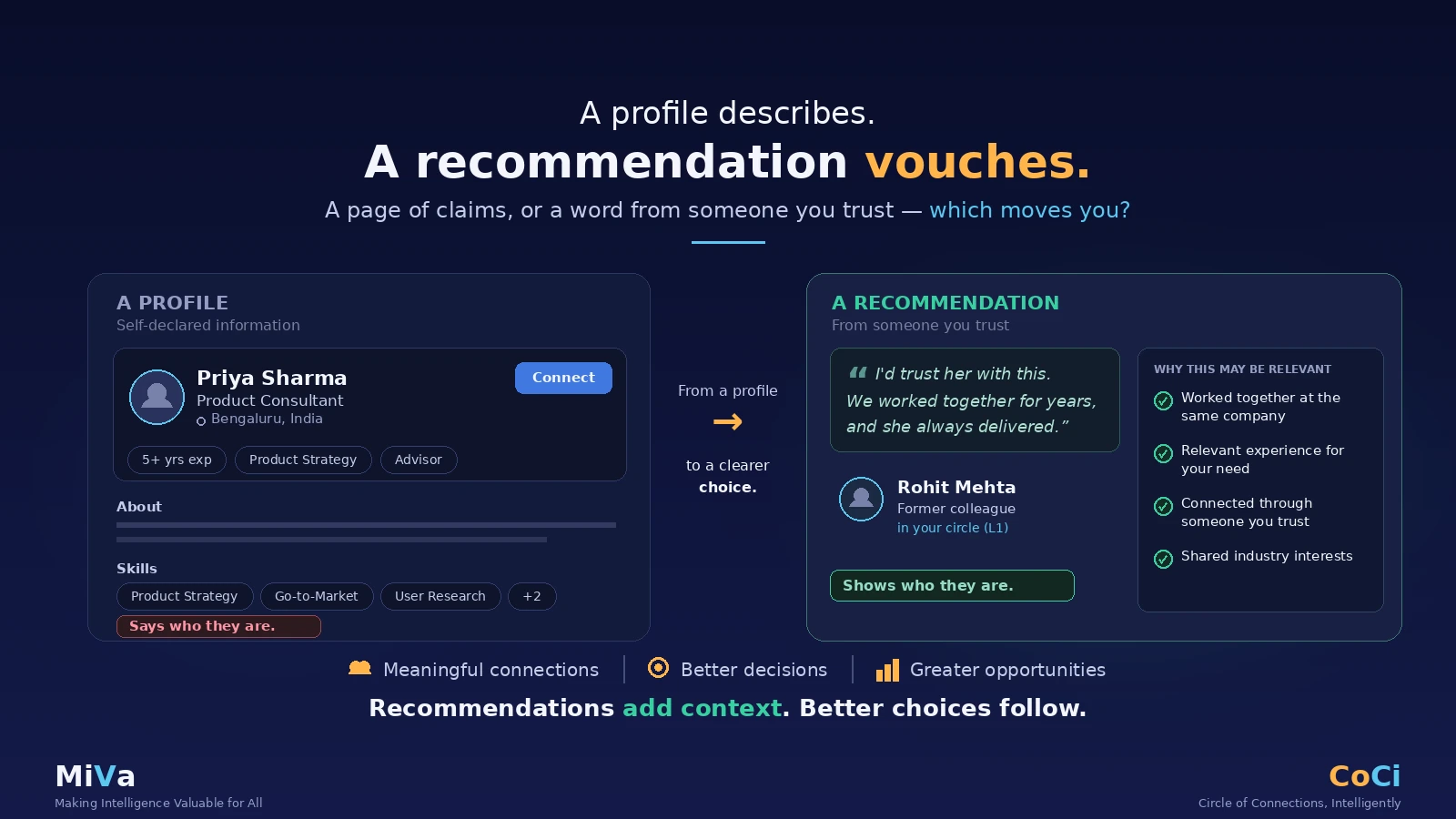
A profile tells you about a person
Profiles are useful.
They help people introduce themselves and make important information easy to discover. You can learn about someone's experience, education, skills, interests, company and professional background.
Without profiles, online discovery would be much harder.
But profiles are usually written as information about the person.
They do not necessarily tell you why that person is relevant to your situation.
A profile gives you information. A recommendation can give you context.
Recommendation does not have to mean endorsement
There is an important distinction here.
A recommendation does not automatically mean, “This person is trustworthy in every situation.”
It can simply mean, “This person may be relevant to what you are looking for, and here is why.”
That difference is important because trust should not be reduced to one person's opinion.
A good recommendation should help you investigate further, not make the decision for you.
For example, knowing that a former colleague worked with someone is useful context. It does not mean you should automatically hire that person.
It gives you a better starting point.
Relevance can be more useful than completeness
Imagine two profiles.
Profile A has twenty skills, fifteen certifications and years of impressive experience.
Profile B has fewer visible credentials but has worked on almost exactly the problem you are trying to solve.
Which profile is more useful?
There is no universal answer.
But if you only compare profiles, the most impressive profile may win your attention.
A recommendation can introduce another question:
“Why is this person relevant to me?”
That question can save time because it moves the decision away from generic information and toward the specific situation.
The best recommendations contain reasons
A weak recommendation simply gives you a name.
A stronger recommendation gives you a reason.
“Talk to Priya.”
is less useful than:
“Priya has worked on similar product problems, and you are connected through a former colleague.”
The second version does not guarantee that Priya is the right person.
But now you know why the person appeared.
You can decide whether that reason matters to you.
The value of a recommendation is often not the name. It is the explanation around the name.
Relationships can make recommendations more meaningful
This becomes even more interesting when recommendations are connected to relationships.
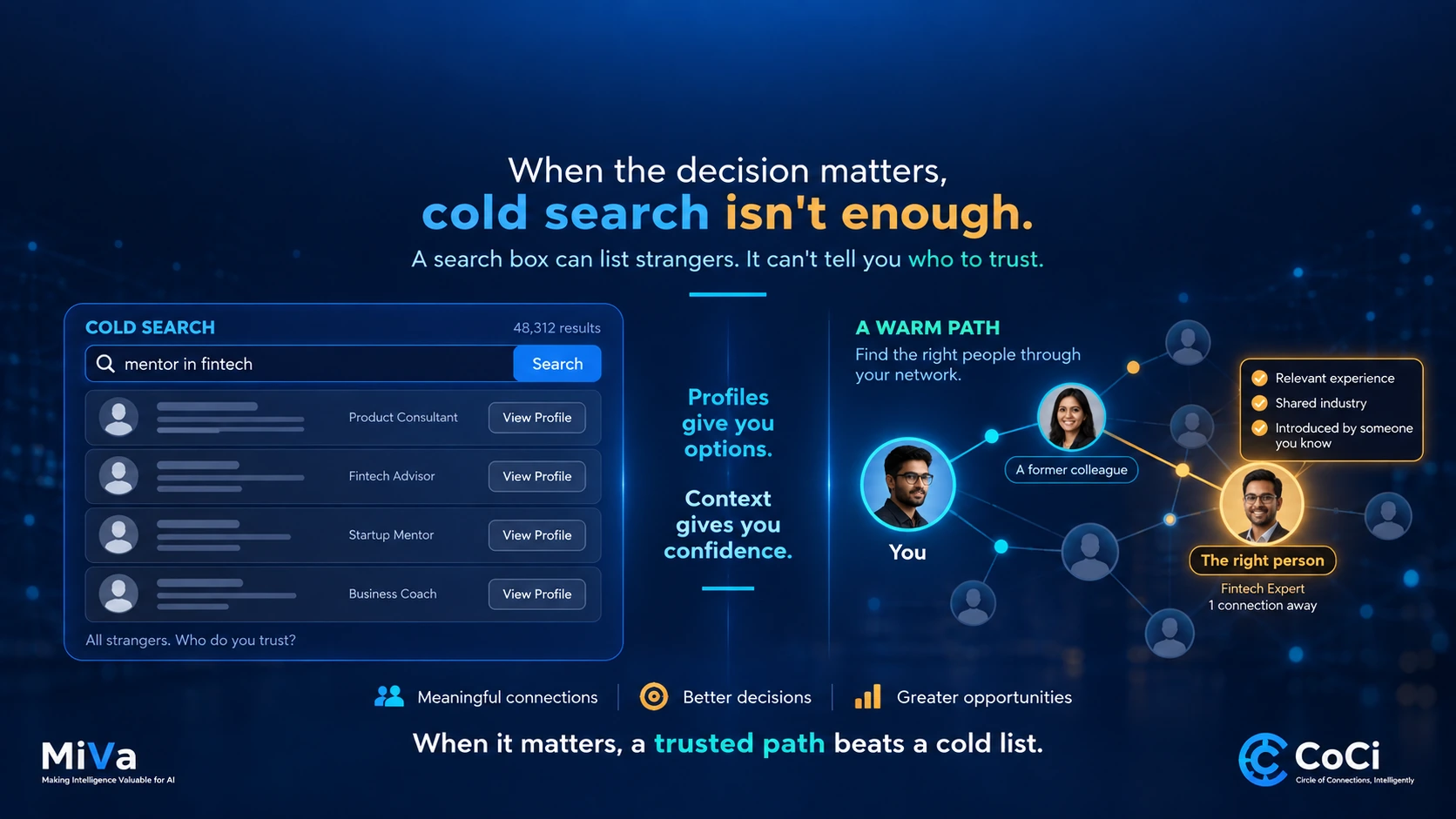
Suppose you are looking for a mentor in a new industry.
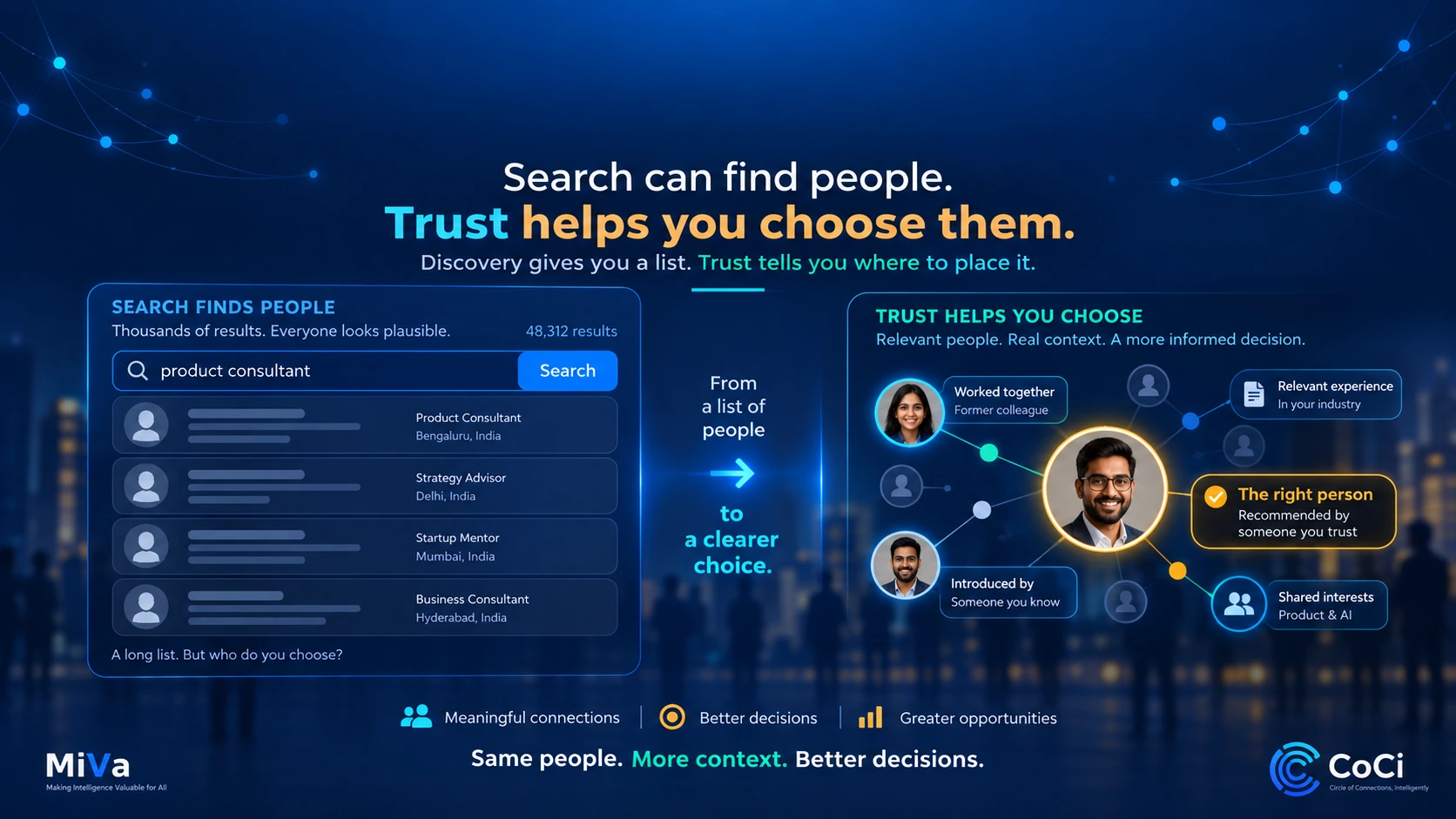
A search can give you hundreds of possible people.
A profile can help you understand their backgrounds.
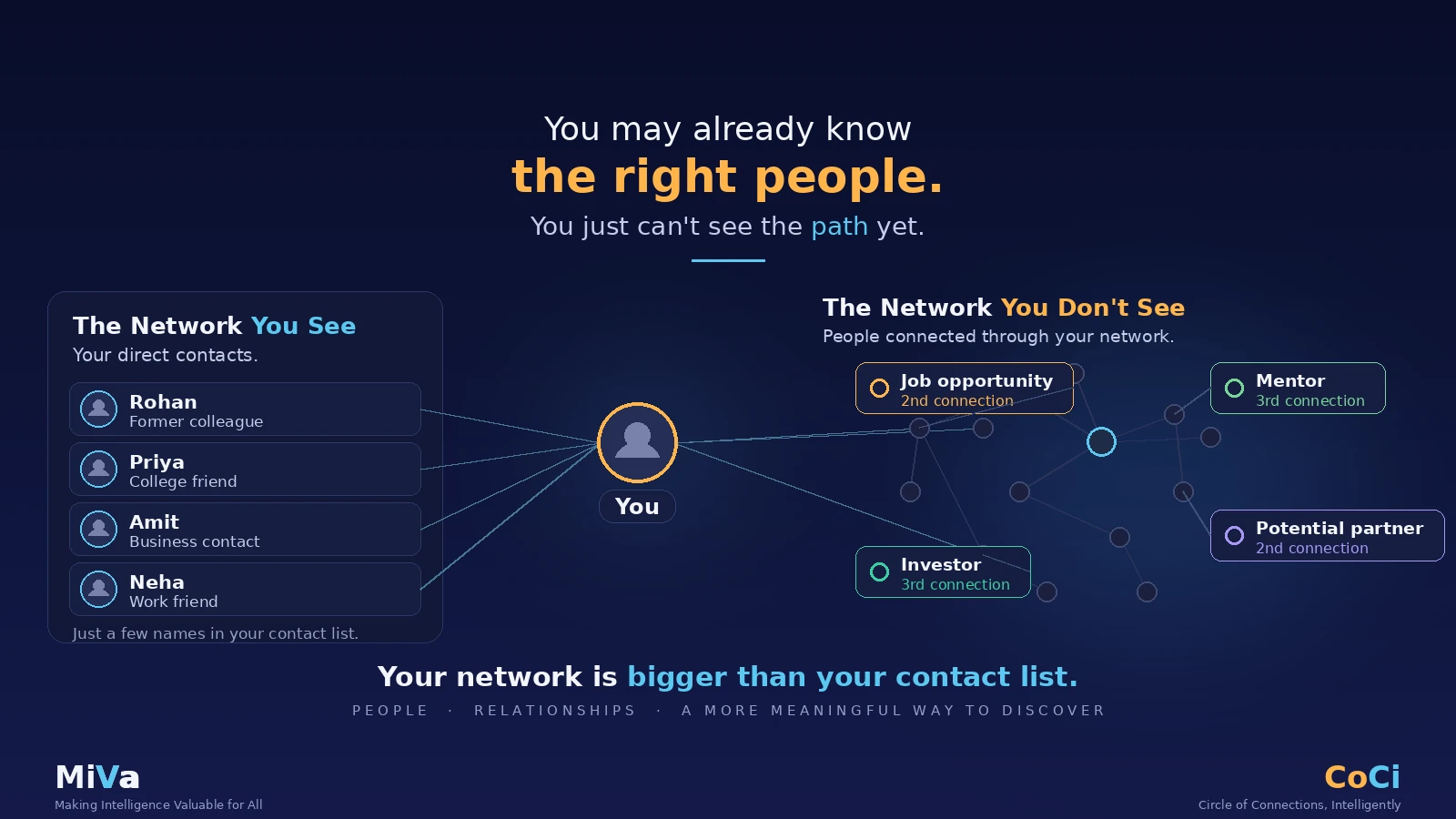
But discovering that someone in your network already knows one of those people gives you another layer of context.
You now have a reason to explore that person further.
That is the kind of relationship-aware discovery that CoCi (Circle of Connections, Intelligently) by MiVa AI Systems is designed to support.
CoCi's current experience includes relationship-based recommendations across scopes including L1, L3 and Global. The idea is to help make discovery more understandable by showing people in relation to your network rather than only as isolated profiles.
AI can help surface the right context
The challenge is scale.
Even if useful relationships exist around you, you cannot manually inspect every possible path every time you need someone.
This is where AI can help.
AI can understand what you are looking for, identify potentially relevant people and help surface relationship or profile context that might otherwise remain hidden.
But again, there is an important boundary.
A recommendation is a starting point, not a verdict.
You should still decide whether the person fits your situation.
The future may be about better recommendations, not more profiles
The internet has already made people remarkably discoverable.
The harder problem is making discovery meaningful.
We do not necessarily need another thousand profiles.
Sometimes we need three relevant people, a clear reason they appeared, and enough context to decide who is worth exploring.
That is a very different model of discovery.
A profile tells you who someone is. A useful recommendation helps you understand why they may matter to you.
That is the direction CoCi is exploring.
Curious about what CoCi can do today and what we're building next? See how CoCi is evolving →
Explore CoCi and see how relationship-aware people discovery can add more context to the search for the right person.