How many people do you know?
Probably more than you think.
Friends. Former colleagues. Classmates. Clients. Mentors. Business contacts. People you met at events. People you worked with years ago but still have in your phone.
Yet when something important comes up, we often behave as if we know nobody.
We open Google. We search LinkedIn. We post in a group. We send cold messages to strangers.
The problem may not be that you lack a network. It may be that you cannot see the value inside the network you already have.
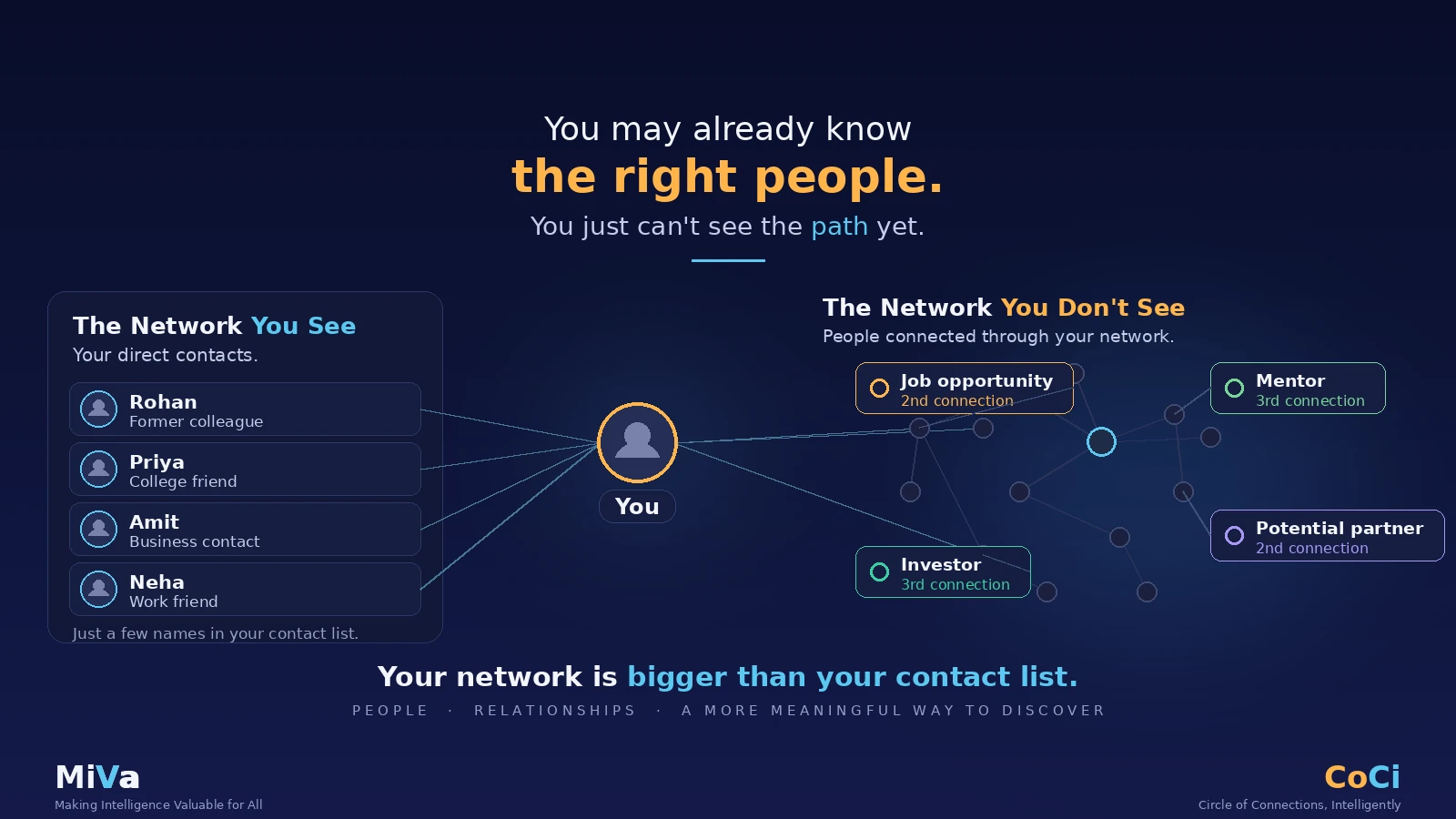
Your network is bigger than your contact list
A contact list is mostly a collection of names and numbers.
Your real network is different. It includes people you have worked with, learned from, helped, met, trusted, recommended, or simply stayed connected to over time.
And those relationships connect you to many more people than the ones you know directly.
Your former colleague may know the hiring manager you need. A friend may know an expert in the field you are entering. Someone you studied with may now work in exactly the industry you want to understand.
The value of a network is not only in the people you know directly. It is also in the people who become reachable through them.
The problem is that most networks are difficult to navigate
We have more digital connections than ever, but most platforms are designed to help us store, display or browse them.
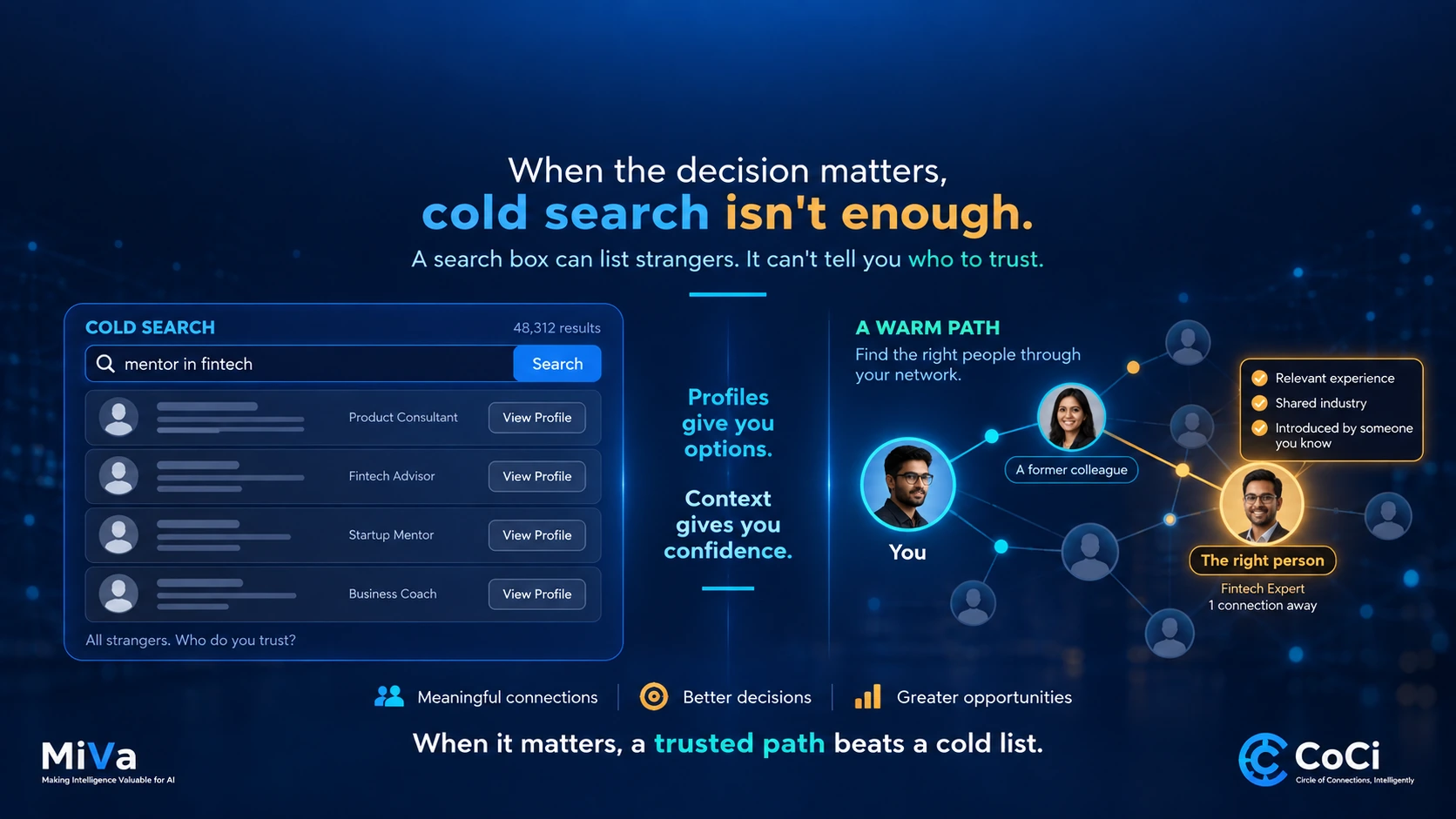
They are good at showing profiles. They are not always good at answering a much more practical question:
“Who, among the people around me, can actually help with this?”
That question becomes especially important when the decision matters.
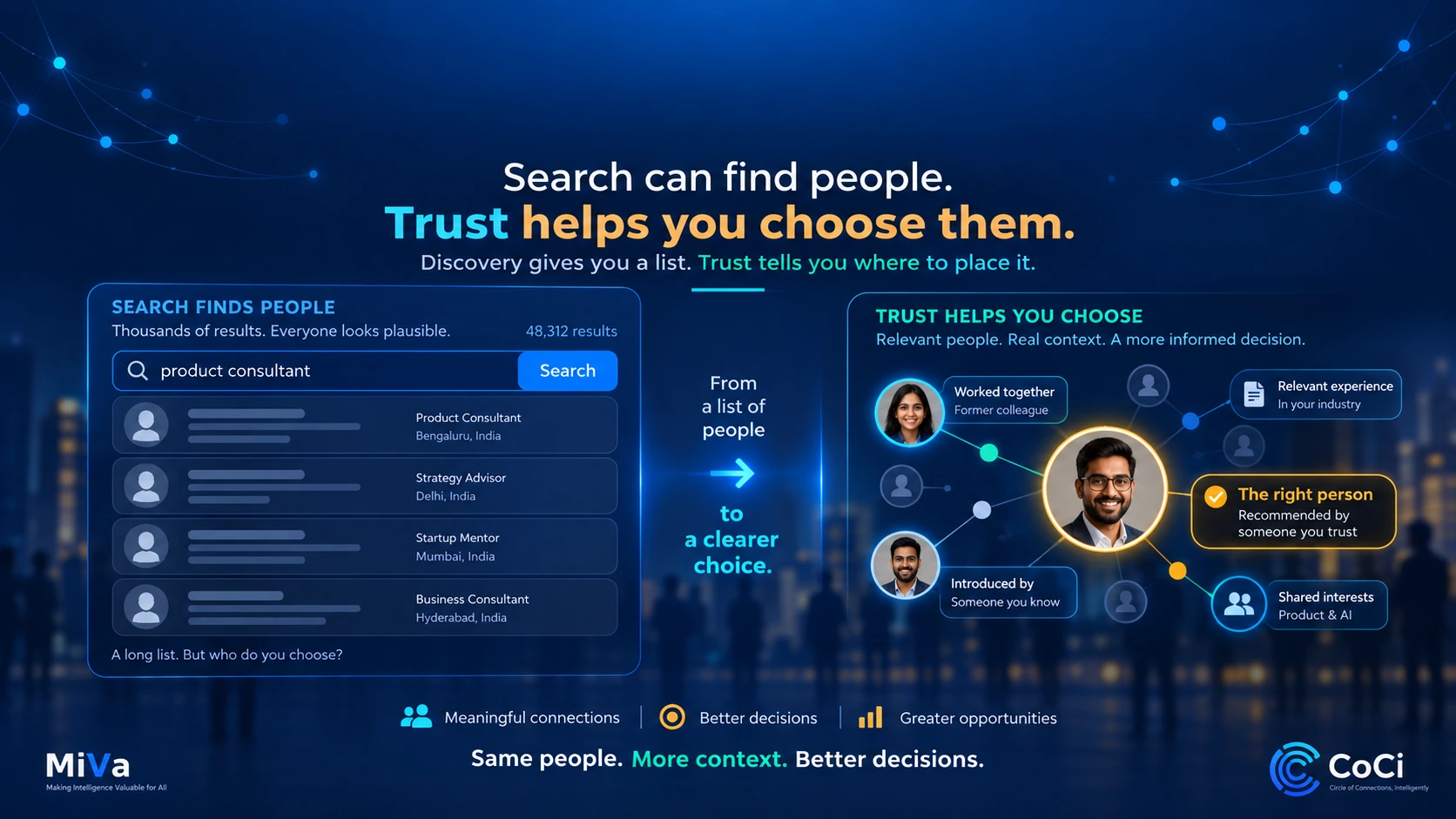
Finding a random article is easy. Finding the right mentor, professional, business contact or career connection is different.
You need relevance. You need context. And sometimes, you need to understand how you are connected to the person before you decide to reach out.
We often start from zero when we are not actually starting from zero
Imagine you want to enter a new industry.
You could search hundreds of profiles, compare job titles, read posts and send connection requests.
Or you might discover that a former colleague already knows someone who has spent years working in that industry.
The second path does not automatically guarantee a better outcome. But it gives you something the first path may not: a relationship you can understand and investigate.
That changes the experience.
You are no longer asking only, “Who is an expert?”
You are also asking, “Who is relevant to me, and how are they connected to my world?”
Your network can contain signals that profiles cannot show
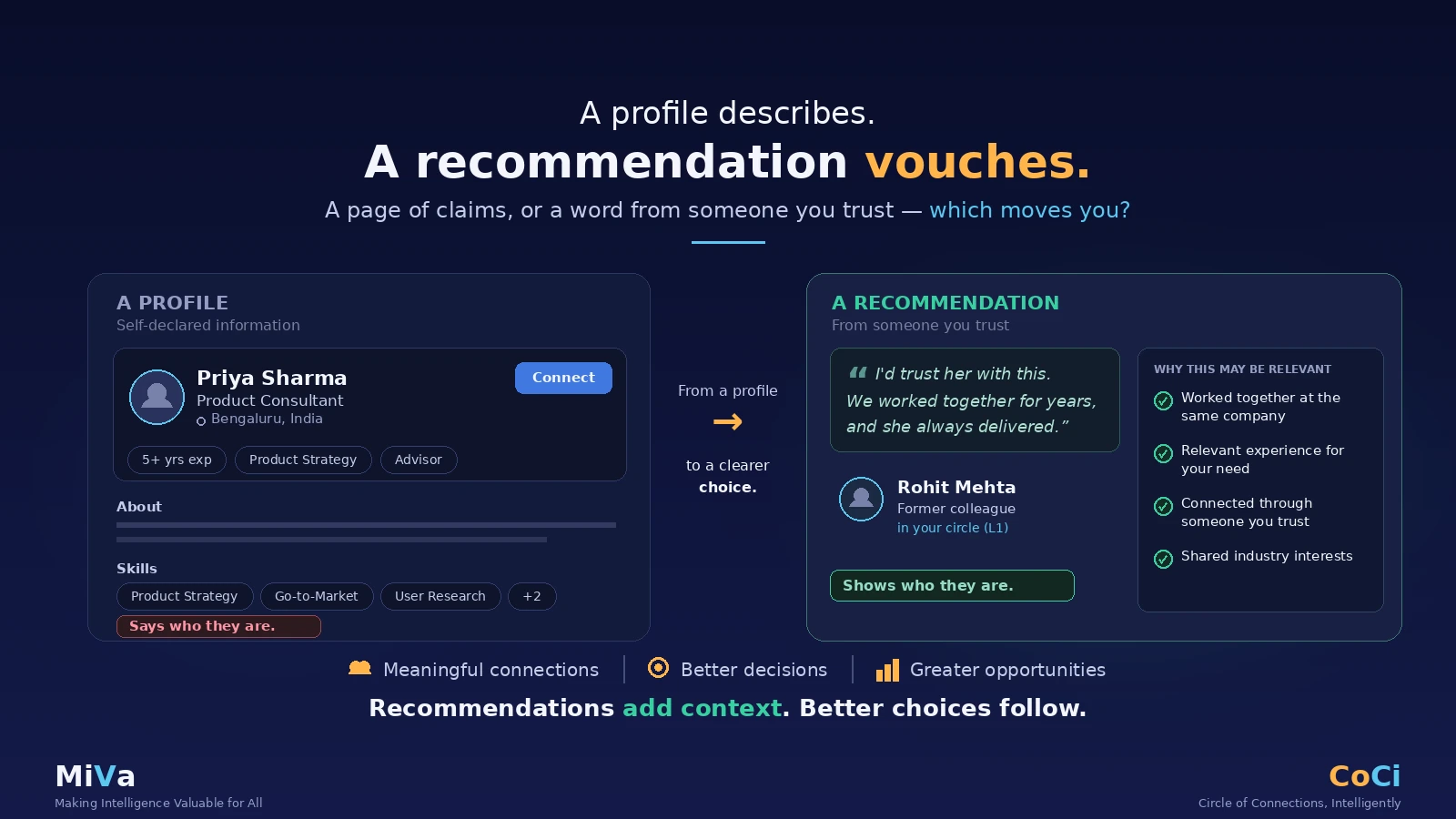
A profile might tell you that someone is a product leader, consultant, designer, founder or engineer.
Your relationships can add another layer of information.
Someone you know may have worked with them. Someone in your extended network may understand their experience. A shared connection may help you put their background into context.
Again, this is not proof that a person is always trustworthy or the right choice.
It is simply more context for a decision.
That distinction matters because trust is rarely created by a single profile field or badge. It is often built from several pieces of information that become meaningful when they are connected.
What if your network could become easier to see?
This is where the idea behind CoCi (Circle of Connections, Intelligently) by MiVa AI Systems becomes interesting.
CoCi is built around relationship-based discovery: helping people find relevant people and understand how they are connected to them and why that connection may be relevant.
The current CoCi experience already supports relationship-based discovery across relationship scopes including L1, L3 and Global. :contentReference[oaicite:1]{index=1}
The larger idea is simple:
Your network should not just be a list of people. It should help you understand who may be relevant when you actually need someone.
That is the “hidden value” of the network.
AI can help make the network more useful
There is an obvious challenge here. Even if you have a valuable network, you cannot manually remember every person, every relationship and every possible path through them.
This is one place where AI can be useful.
Instead of making AI the judge of who you should trust, the more useful role is to help you discover possibilities that would otherwise remain hidden.
Find relevant people. Understand the relationship path. See the context. Then make your own decision.
AI can help find the path. People create the trust.
The network you already have may be more valuable than you realize
We often think of networking as something we need to build from scratch.
But many of us already have years of relationships around us. The real problem is that those relationships are scattered across contact lists, social platforms, old conversations and memories.
What is missing is not necessarily more connections.
Sometimes it is simply a better way to understand the connections we already have.
That is one of the ideas CoCi is being built around: making relevant people and relationship paths easier to discover, rather than treating every search as a search from zero.
Curious about what CoCi can do today and what we're building next? See how CoCi is evolving →
Explore CoCi and see a different way to think about your network, relationships and digital discovery.