We connect with people online every day.
We meet professionals on networking platforms, find experts through search, discover service providers through directories, join communities, follow creators, and message people we have never met in person.
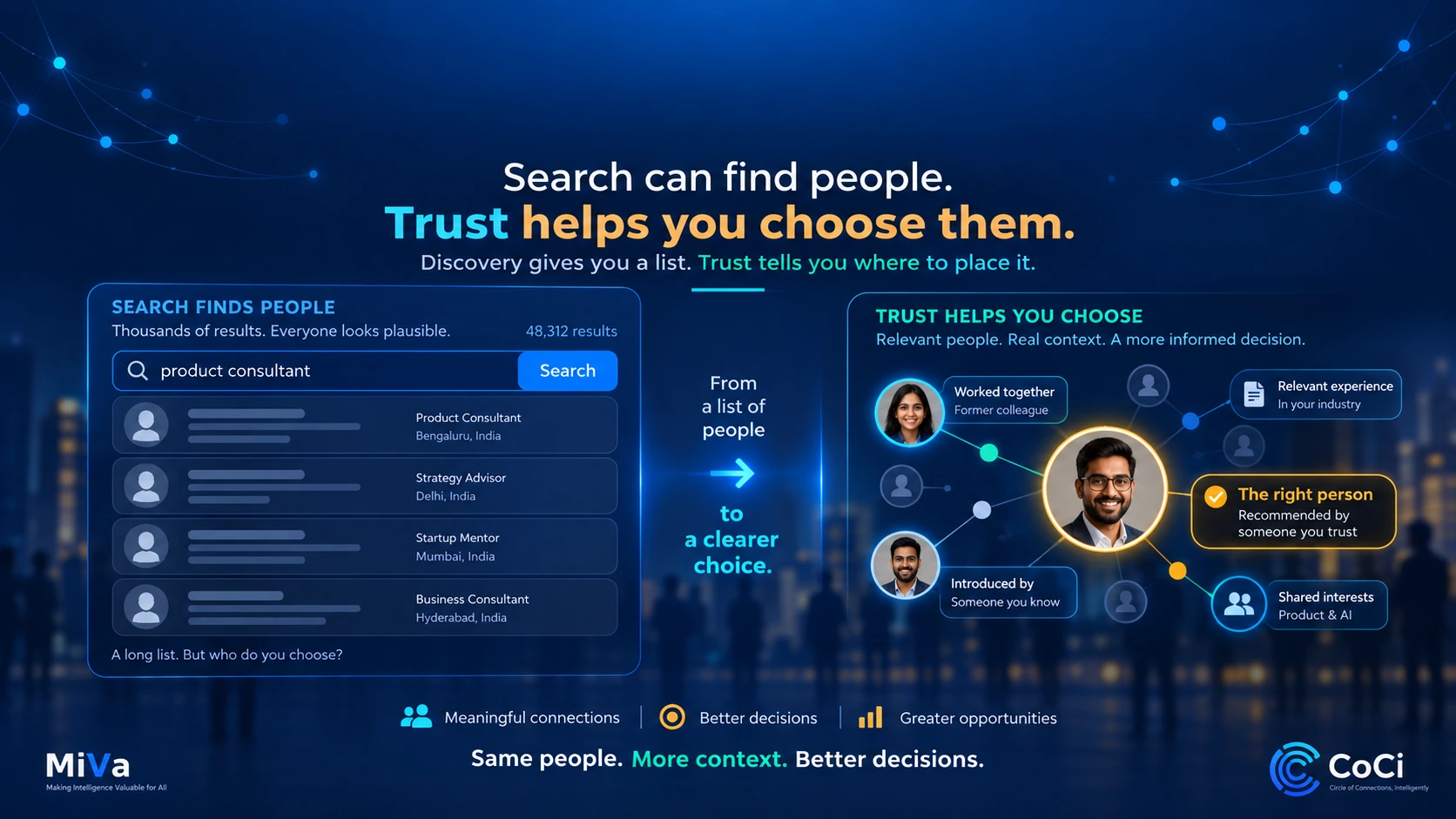
Most of the time, finding someone is easy.
But when a connection actually matters, another question comes up:
Can I trust this person?
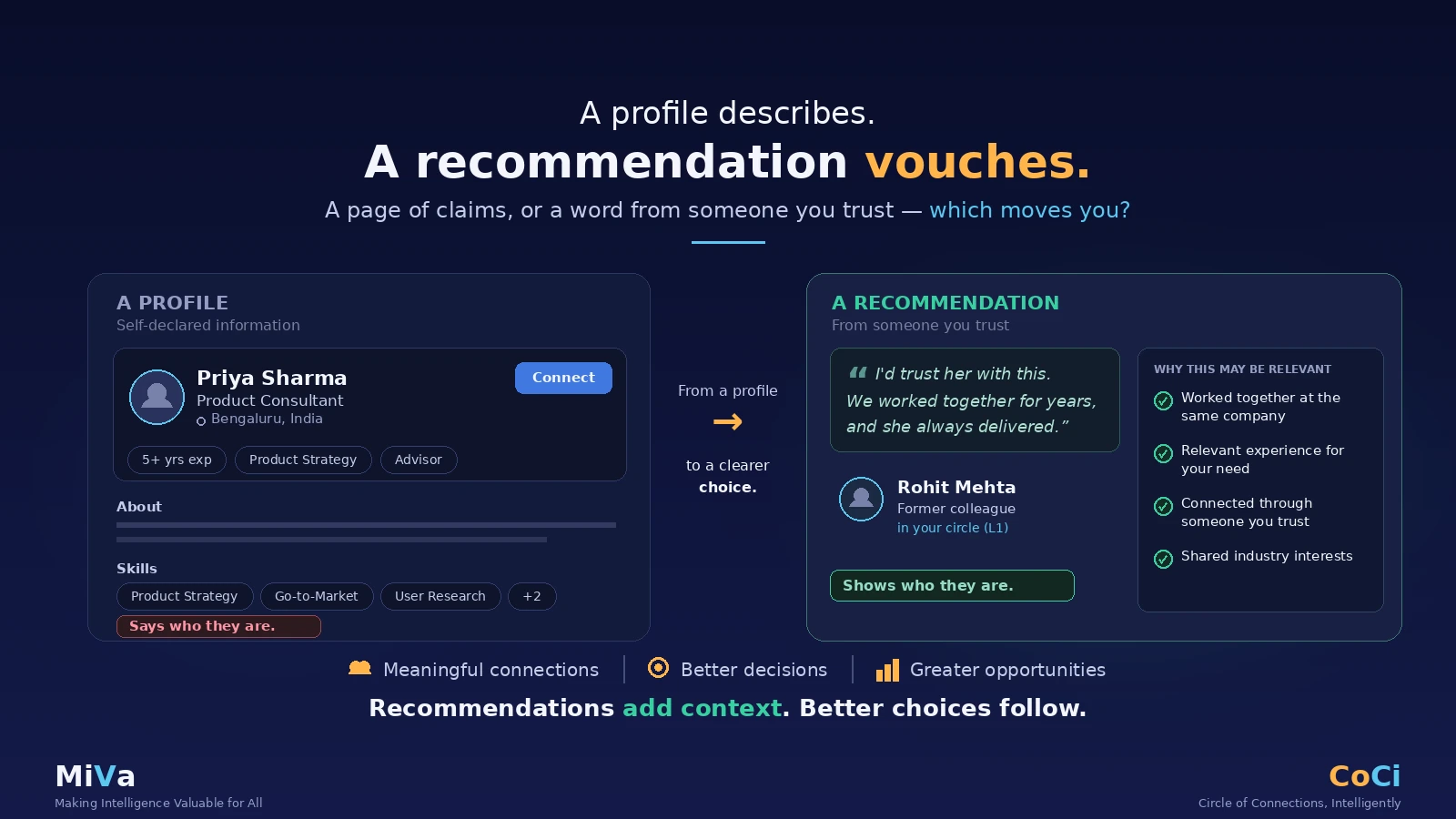
A person may have impressive qualifications and still not be the right fit. Someone may have thousands of followers without being someone you would rely on. A polished profile can tell a convincing story without giving you enough context to understand the person behind it.
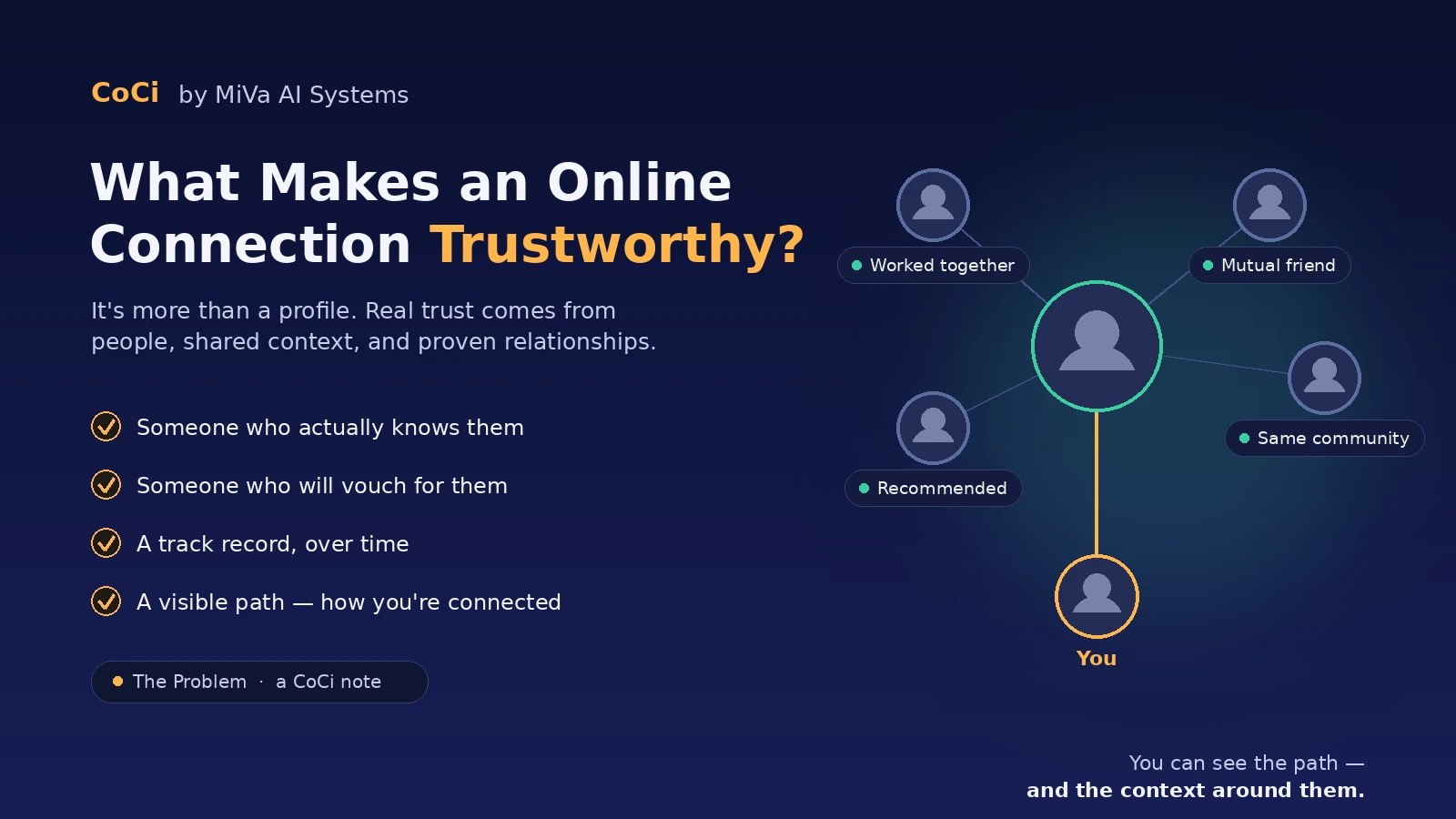
So what actually makes an online connection trustworthy?
Trust is more than a profile
A profile can tell you a lot:
Education.
Experience.
Skills.
Interests.
Achievements.
All of that is useful. But trust usually comes from something more.
It comes from what exists around the person.
Who knows them?
Who has worked with them?
Who has experienced their work?
Who would recommend them?
What kind of relationship do they have with the people around them?
These signals cannot guarantee that someone will always behave exactly as expected. Nothing can.
But they can give you something a profile cannot provide on its own:
better reasons to make an informed decision.
1. Shared experience
One of the strongest signals of trust is real experience.
Someone can say they are an excellent designer, consultant, mentor, developer, lawyer, teacher, or business professional.
But what happens when people actually work with them?
A former colleague may know how they work under pressure. A past client may know how they communicate. A student may know how effective they are as a mentor. A business partner may know whether they follow through.
This is very different from simply reading what someone says about themselves.
Claims describe. Experience demonstrates.
2. Mutual connections
Imagine finding an experienced professional online.
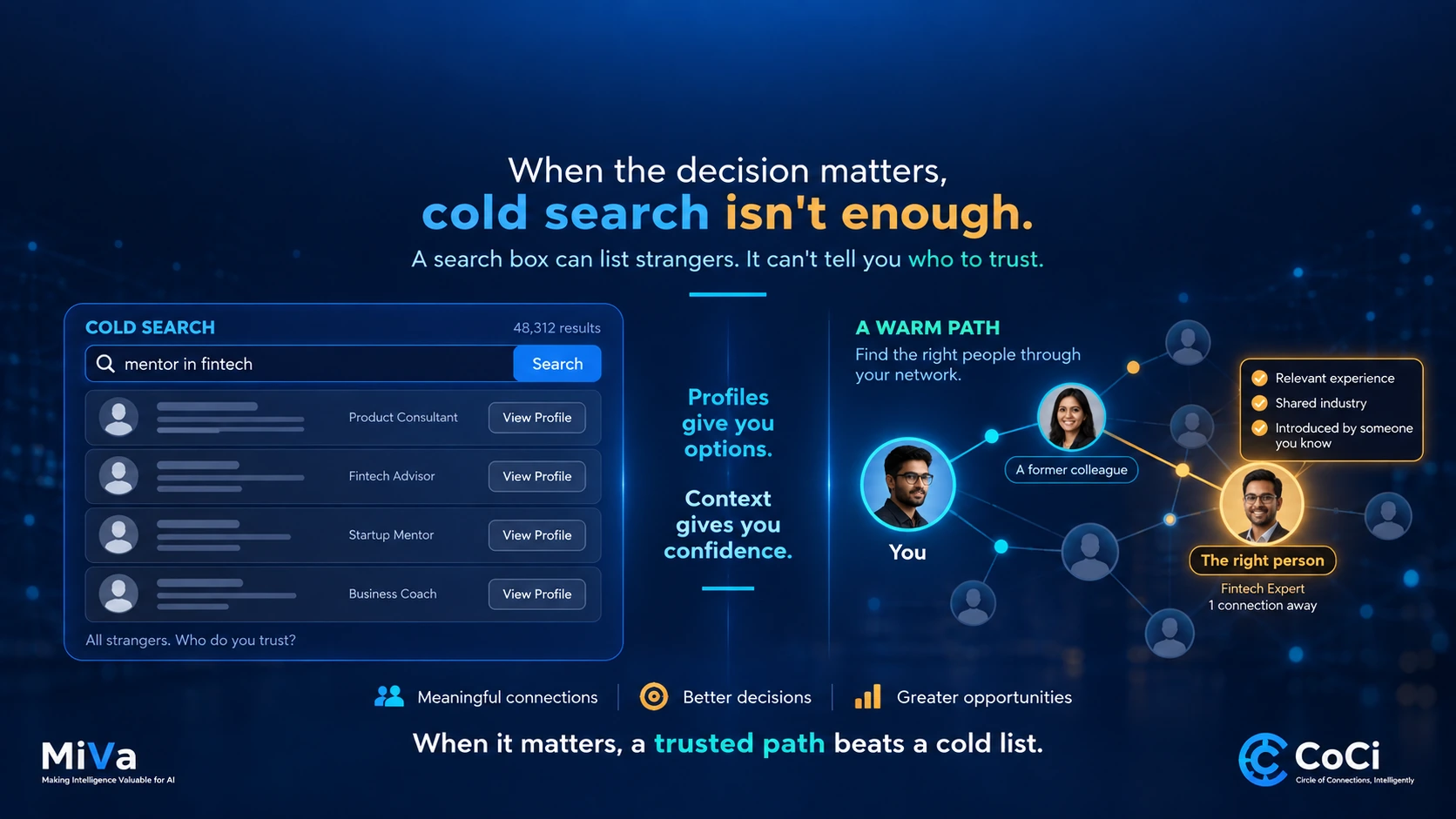
You can contact them as a complete stranger. But what if you discover that someone you already know has worked with them?
The person has not suddenly become different.
But your context has changed.
You now have a possible reference point. You may be able to ask questions, understand the relationship, or approach the person with greater confidence.
That is why the structure of a network can matter almost as much as the people in it.
3. Relevant recommendations
A recommendation is useful because of its context, not simply because someone wrote it.
A recommendation from someone who has actually worked with a person may tell you more than a generic endorsement from someone who barely knows them.
And relevance matters too.
A highly experienced software engineer may not be the right person to advise you on fundraising. An excellent teacher may not be the right business consultant for your company.
So trust needs context.
Who is making the recommendation, why are they making it, and is it relevant to what you need?
4. Consistency over time
Trust is rarely established in one moment.
It develops over time through repeated behavior.
People build trust when they do what they say, communicate consistently, treat others responsibly, and deliver on their commitments.
That is why long-term reputation can tell you more than a single line on a profile.
A profile is a snapshot. Trust is a pattern.
5. Relevant context
Trust is also situational.
The question is not always:
“Is this person trustworthy?”
A more useful question may be:
“Is this person relevant and reliable for what I need right now?”
Someone may be highly trusted in one area but have little relevant experience in another. A great mentor for one stage of a career may not be the right mentor for another. A service provider may have an excellent reputation for one kind of work but no experience with the problem you need solved.
That is why digital trust needs to consider not only identity, but also relevance.
6. Relationships are not all equal
Not every connection carries the same meaning.
There is a difference between someone you have worked with for years, someone you met once, someone who simply follows you online, and someone who is connected to you through a trusted colleague or community.
The existence of a connection is one thing.
The nature of that connection is another.
This is why simple connection counts can be misleading.
Sometimes ten meaningful relationships can be more useful than ten thousand weak ones.
7. Useful evidence matters, but more is not always better
Trust does not have to depend entirely on what people say about themselves.
Where appropriate, additional signals can provide useful context around identity, experience, relationships, or activity.
But more verification does not automatically mean more trust.
A good trust system should provide useful evidence without asking people to reveal unnecessary personal information.
The goal is not to collect everything about someone.
The goal is to provide enough meaningful context to support a better decision.
Trust is not the same as certainty
This distinction matters.
No digital platform can reasonably promise that everyone will always behave perfectly.
Trust is not a guarantee.
It is a basis for making decisions with better information and better context.
A reliable digital system should also be honest about what it does not know.
People should be able to understand:
What is known.
What is supported by relationships or experience.
What is relevant.
And what remains uncertain.
Good trust systems make uncertainty easier to understand. They do not hide it.
Why a trust score alone is not enough
It is tempting to reduce digital trust to one number.
100 points.
Five stars.
A badge.
A green check.
These signals are easy to understand. But a number can also hide the context that makes trust useful.
Why is the score high?
Who contributed to it?
Is it relevant to your situation?
How recent is the evidence?
What kind of relationship exists?
What does the score actually represent?
When a decision matters, understanding why can be more useful than simply knowing how much.
Trust should be understandable
This leads to a broader principle:
Digital trust should be explainable.
When a platform surfaces a person as potentially relevant, users should be able to understand the context behind that discovery.
Not just:
“Here is someone who matches your search.”
But potentially:
“Here is why this person may be relevant, and here is the relationship context that connects you to them.”
That difference can make a digital interaction feel much more human.
This is where CoCi is exploring a different approach
CoCi by MiVa is being built around the idea that meaningful digital connections should consider more than isolated profiles.
CoCi starts with relationships and context.
Rather than looking only for a person, the broader idea is to help people understand how a person may be connected to them.
That relationship context can become one of the signals that helps people make a more informed decision.
This direction also fits with MiVa's broader work around human-centric and trustworthy technology.
Where AI can help
As networks grow, it becomes harder for people to evaluate every possible connection themselves.
This is where AI can be useful.
AI can help interpret information, identify patterns, understand what a person is looking for, and surface potentially relevant connections.
But the goal should not be to replace human judgment.
AI can help you understand the context around a connection. It should not decide whom you must trust.
A simple example
Imagine you are looking for someone who can help you understand a new industry.
You find three people online.
Person A has an impressive profile and thousands of followers.
Person B has fewer followers but several years of relevant experience.
Person C has similar experience, and someone you already know has worked with them and recommends their work.
Who should you contact?
There is no universal answer.
But Person C gives you something the other profiles may not:
relationship context.
You can investigate further. You can ask questions. You can use your own judgment.
The network has not made the decision for you.
It has simply given you a better starting point.
The future of digital trust may be about context
We are moving from a world where digital identity was largely represented by forms and profiles toward one where AI systems increasingly act on our behalf.
In that world, knowing who someone is may not be enough.
Systems may also need to consider relationships, context, history, relevance, and the reasons behind our confidence in someone.
That does not mean building a perfect trust machine.
It means building better tools for navigating uncertainty.
Trust is built by people
Technology can organize context.
AI can help interpret patterns.
Platforms can surface relevant relationships.
But trust remains human.
It develops through experience, behaviour, relationships, recommendations, and time.
That is why the future of digital connection should not be about replacing human trust with an algorithm.
It should be about using technology to make the human signals around trust more visible and useful.
So, what makes an online connection trustworthy?
There is no single answer.
But trust becomes easier to assess when people have access to signals such as:
Shared experience.
Relevant relationships.
Meaningful recommendations.
Consistency over time.
Context that fits the situation.
Useful and proportionate verification.
Most importantly, people should be able to understand why those signals matter.
That is the direction CoCi is exploring.
Not just another profile.
Not just another connection count.
More context around the people who matter.
Explore CoCi and MiVa's products, learn more about our AI and intelligent system solutions, or contact MiVa AI Systems.