Who are you online?
Today, that question has become relatively easy to answer.
You may have a name, photo, job title, company, education, location, social profiles and a long list of connections. Put them together and you have what most platforms call your digital identity.
But there is another question that is much harder:
Can I trust you for what I need right now?
That is a different problem.
And as more of our decisions move online, the difference between identity and trust is becoming harder to ignore.
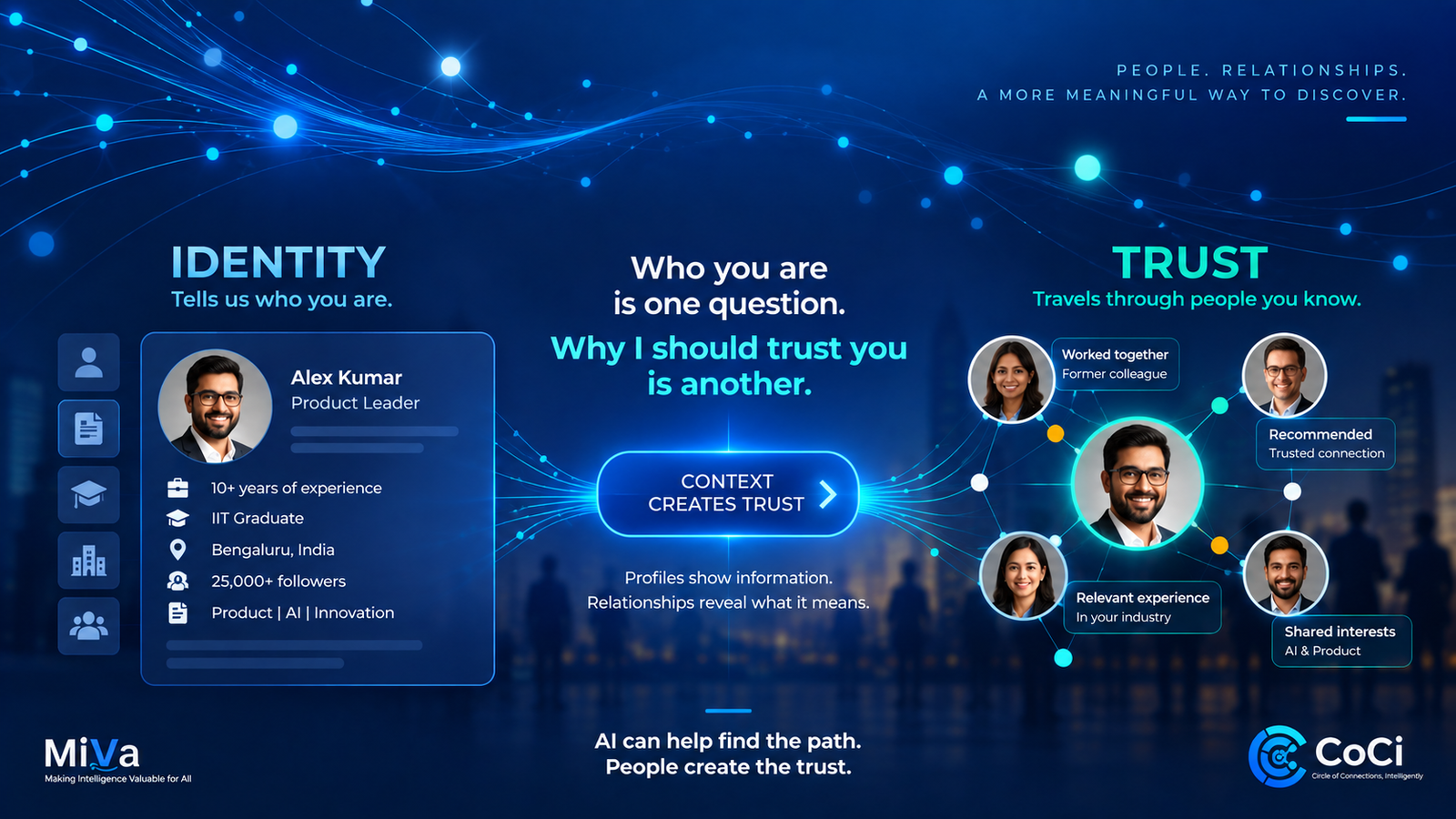
Identity tells us who you are. Trust asks what that means.
Digital identity is mainly about recognition. It helps answer questions like: What is your name? What do you do? Where have you worked? What are you interested in?
Those things matter. But they are mostly information about you.
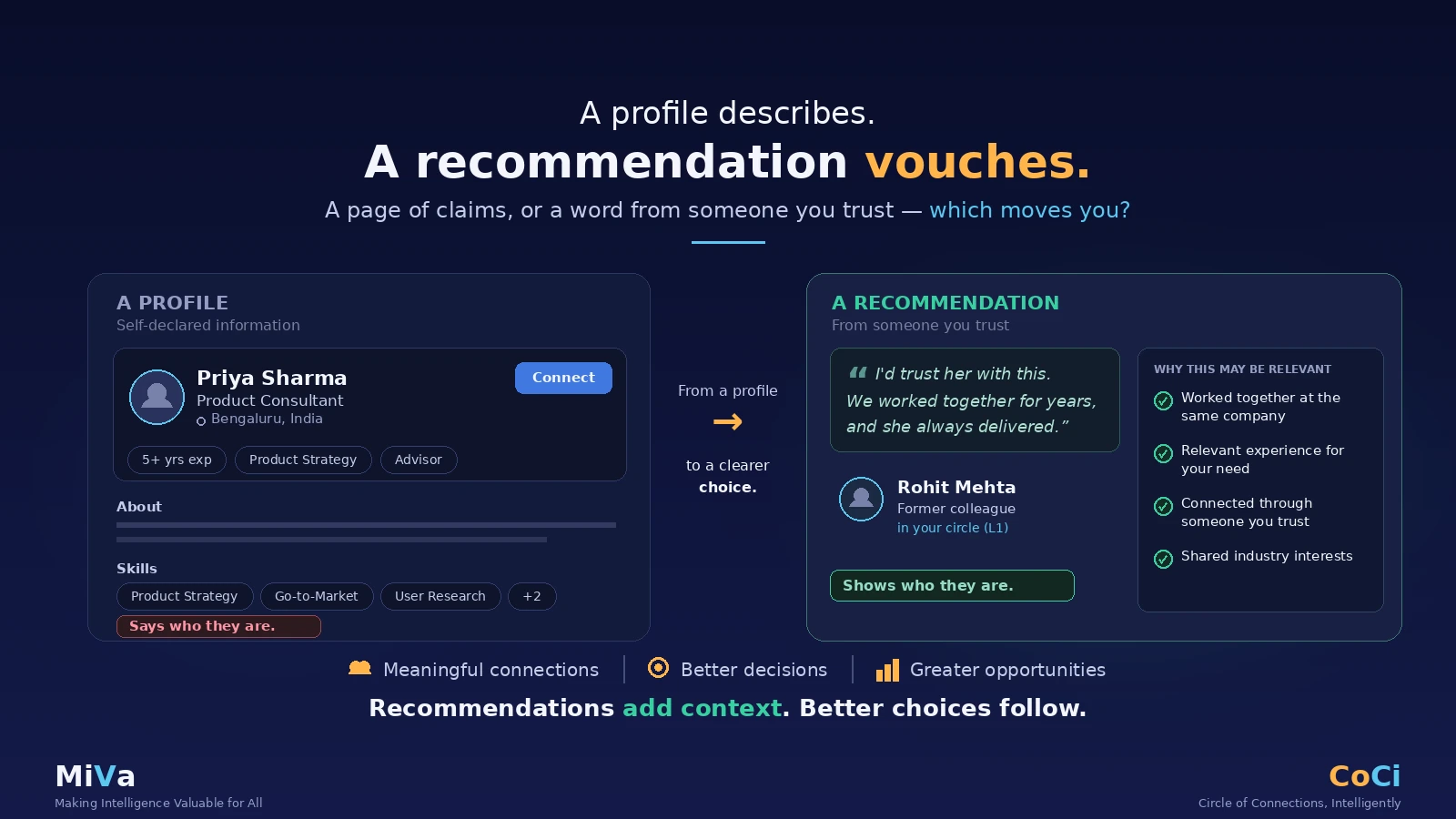
Trust is more contextual. It asks whether your experience is relevant, whether your reputation means something to me, whether people I know have worked with you, and whether there is enough context for me to make a decision.
Identity can establish who someone is. It does not automatically establish why you should trust them.
A complete profile can still leave important questions unanswered
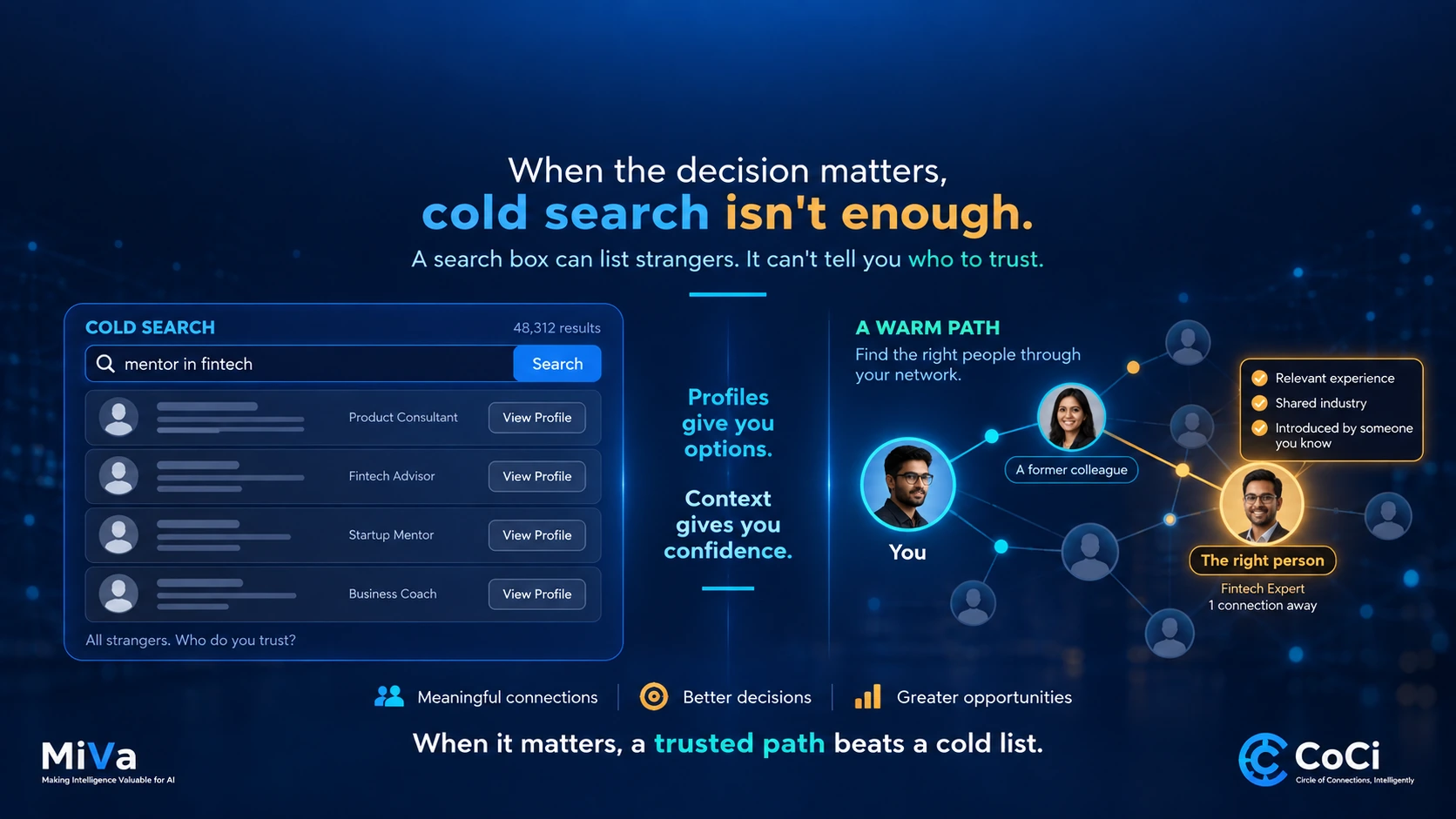
Imagine you are looking for a mentor in a new industry.
You find someone with an impressive profile. Their experience looks relevant. Their education is strong. They have worked at good companies and have a large online presence.
But what do you still want to know?
Have they actually worked in the area you need help with? Has someone you know worked with them? How are you connected? Is there someone who can give you useful context about them?
Your profile may answer “Who is this person?” without answering “Why might this person be right for me?”
We often use identity signals as shortcuts for trust
This is where things become interesting.
Because trust is difficult to measure, we often borrow visible signals from identity. A verified-looking profile feels trustworthy. A famous company on a résumé feels reassuring. A large following can create authority. A polished profile can create confidence.
None of these signals are useless. They can all provide valuable information.
The problem starts when we treat one visible signal as if it answers the whole trust question.
Trust is rarely just a fact about a person. It is a relationship between a person, another person, and a specific situation.
Context is the missing layer
Consider two people with almost identical profiles.
Both have ten years of experience. Both have worked in the same industry. Both describe themselves as experts.
Now imagine that one of them has previously worked with a person you know and trust. That person can explain what it was actually like working with them.
Suddenly, you have something your profile could not provide on its own.
You have relationship context.
That does not guarantee a perfect outcome. But it gives you another signal to consider before making an important decision.
Why this matters more as the internet becomes more crowded
The internet has made it incredibly easy to create and display an identity.
We can publish a résumé, build a personal brand, collect followers, create a portfolio and present ourselves in ways that are difficult to compare with the context of everyday human relationships.
At the same time, people are increasingly using digital platforms to make decisions that matter: choosing a professional, finding a mentor, exploring a career opportunity, selecting a service provider, or deciding who may be worth speaking to.
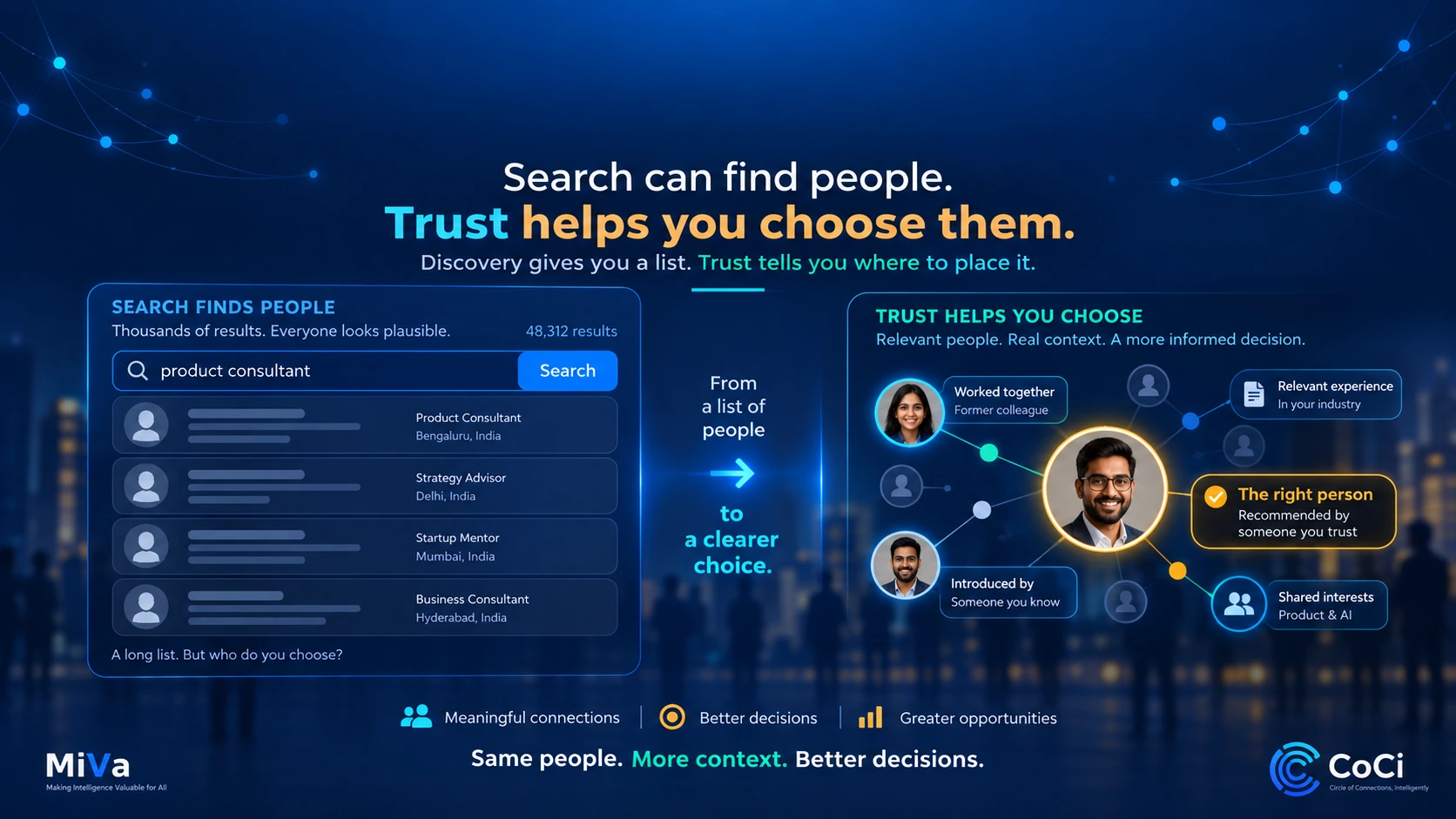
These decisions need more than discoverability.
They need context.
This is where CoCi takes a different approach
This is one of the ideas behind CoCi (Circle of Connections, Intelligently) by MiVa AI Systems.
CoCi is built around the idea that discovering a person can be more useful when you can also understand how you are connected to them and why that connection may be relevant.
The current CoCi experience already supports relationship-based discovery, including relationship scopes such as L1, L3, and Global, rather than treating people as isolated profiles.
That changes the question from:
“Who is this person?”
toward:
“Who is this person, how am I connected to them, and what context should I know before I decide?”
That distinction is central to the direction CoCi is building toward. The product vision is not simply about showing more profiles; it is about combining relevance, relationship context, and explainable discovery.
AI can help with the context, but it should not become the judge
There is an obvious challenge here.
Once a network becomes large, nobody can manually understand every relationship, every profile and every possible connection. This is where AI can become useful.
AI can help organize information, understand what someone is looking for, discover relevant people and explain why a result may be worth exploring.
But there is an important boundary:
AI can help surface context. It should not replace human judgment about trust.
That principle is important for CoCi as its intelligence and trust foundations evolve. The goal is not to tell people whom they must trust, but to help them make better-informed decisions.
The future of digital identity may be less about proving who you are
Identity will remain important. We need ways to recognize people, understand their background and distinguish one person from another.
But that may no longer be enough.
As online interactions become more important, we may need systems that connect identity with something deeper: relationships, experience, relevance and context.
Because when a decision matters, knowing someone's name is only the beginning.
Identity tells you who someone is. Context helps you understand what that relationship might mean.
That is the direction CoCi is exploring: moving digital discovery from isolated profiles toward people, relationships and meaningful context.
Curious about what CoCi can do today and what we're building next? See how CoCi is evolving →
Learn about CoCi and explore a different way to think about digital identity, trust and human connections.