A good profile can tell you a lot about a person.
It can tell you where they work, what they have studied, what they do, what they say they are good at, and how they want to be seen.
But when a decision actually matters, we usually want to know something more:
Can I trust this person?
That is a much harder question.
Because trust rarely comes from information alone. It comes from context, relationships, experience, consistency, recommendations, and the people who are willing to stand behind someone.
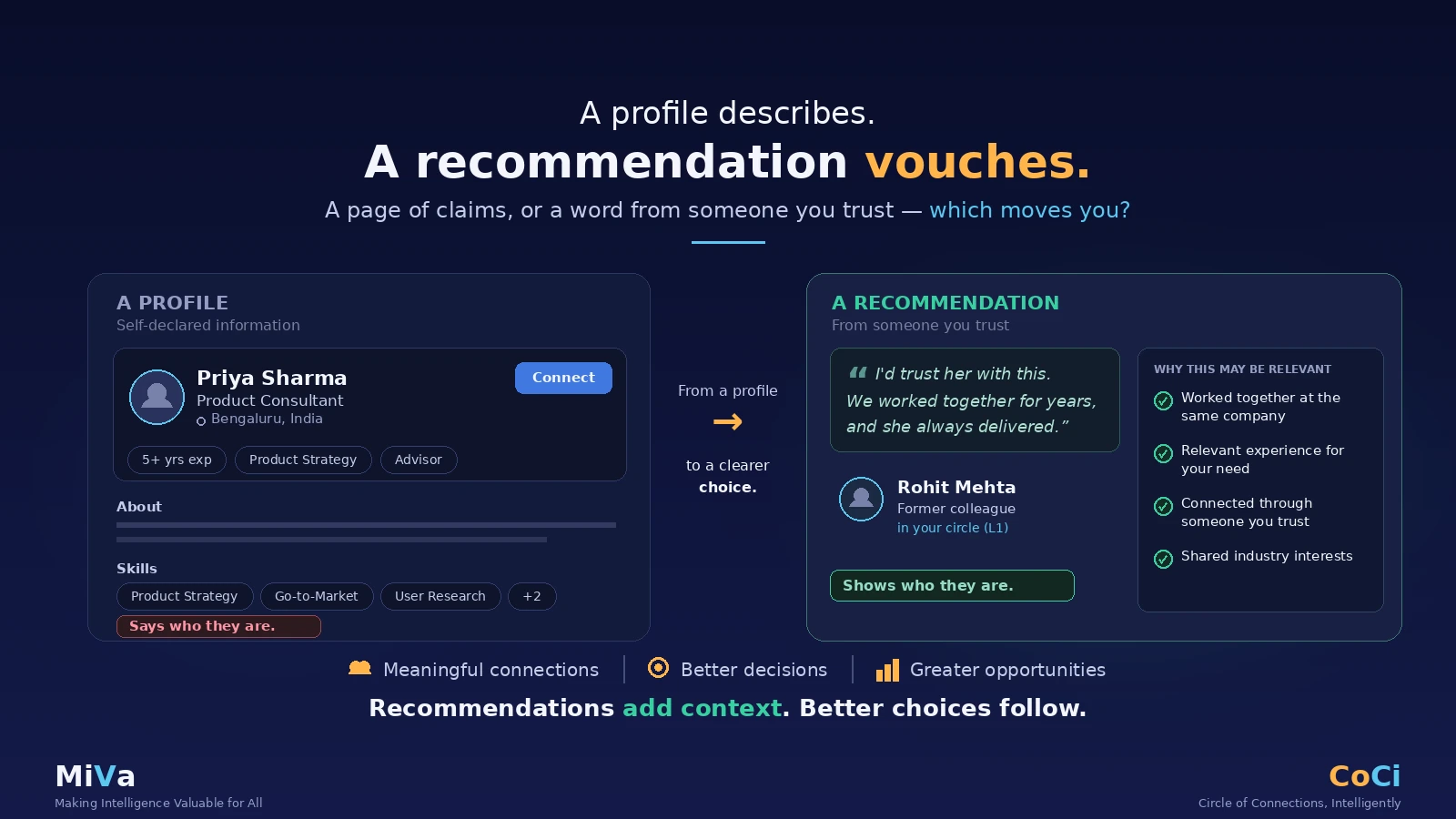
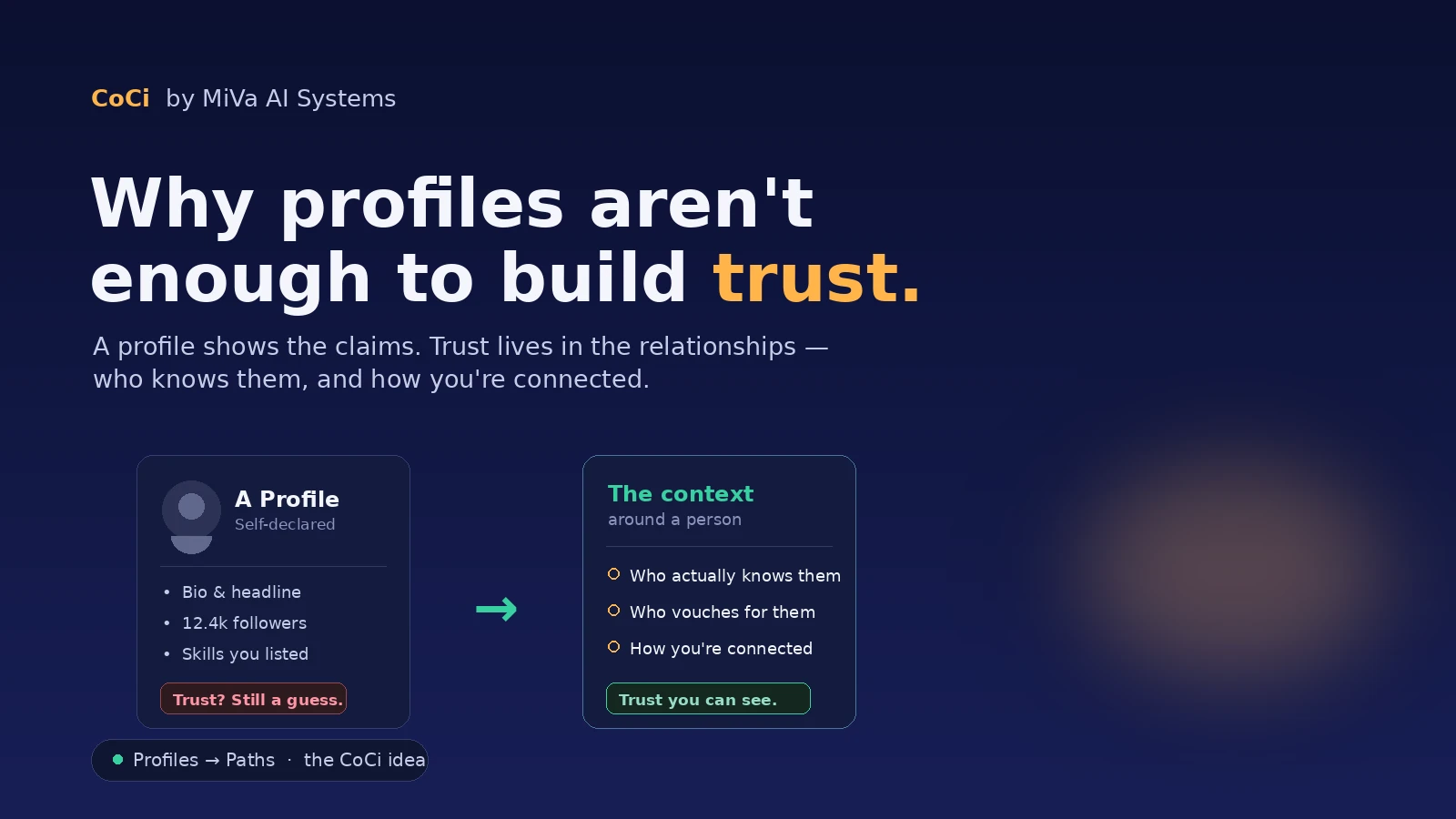
A profile tells you about a person. It does not tell you the whole story.
Imagine you are looking for a mentor.
You find a professional with an impressive background. Their profile looks relevant. Their experience matches what you need. Their credentials seem strong.
But then comes the natural question:
How do I know this is the right person for me?
You may want to know whether someone in your network knows them. Whether they have helped people like you. Whether their experience is relevant to your situation. Whether someone you already trust would recommend them.
A profile can provide information.
It cannot, by itself, provide all of that context.
The internet has become very good at profiles
Digital platforms have made it remarkably easy for people to present themselves online.
We have professional profiles, social profiles, business pages, portfolios, reviews, bios, resumes, ratings, and directories.
This has created an enormous amount of searchable information.
But more information does not automatically create more trust.
In fact, the opposite can sometimes happen.
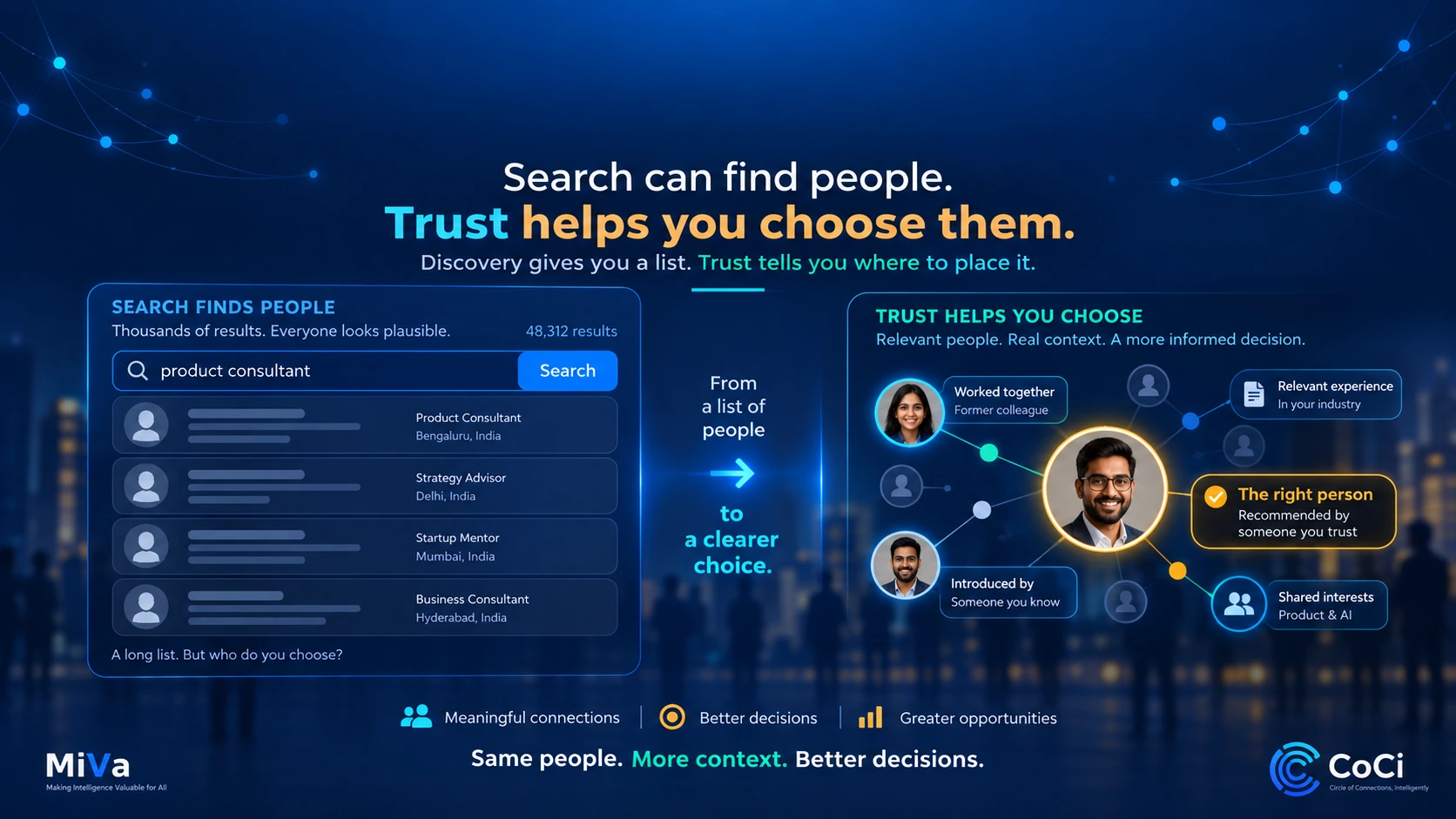
When you have hundreds of possible people, services, experts, and opportunities to choose from, the difficult part is no longer finding someone.
The difficult part is deciding whom to believe, whom to approach, and whom to trust.
Trust is relational, not just informational
Think about how people normally make important decisions offline.
Before hiring a professional, you might ask a friend:
“Do you know someone reliable?”
Before choosing a mentor, you may ask a colleague:
“Do you know someone who has done this before?”
Before doing business with someone new, you may ask:
“Has anyone you trust worked with them?”
The recommendation does not guarantee a perfect outcome.
But it gives you something a profile often cannot:
relationship context.
You are not just seeing a person.
You are seeing how that person relates to people you already know, trust, or understand.
Why “who knows them?” can be more useful than “who are they?”
This does not mean profiles are useless.
They are extremely useful.
The problem is trying to make them do a job they were never designed to do.
A profile is good at answering questions such as:
What does this person do?
What experience do they have?
What skills do they list?
What is their background?
But when the decision is personal or important, another layer becomes valuable:
How am I connected to this person?
Who knows them?
Who has worked with them?
Who can provide relevant context?
What is the path between us?
Those questions can matter just as much as the profile itself.
Not every connection carries the same meaning
One of the problems with thinking about networks as simple numbers is that it treats every connection as equivalent.
But we know that is not how relationships work.
You may have hundreds of contacts, but only a smaller group may be people whose judgement you genuinely value.
Some people know you well.
Some people know you professionally.
Some people have worked with you.
Some people simply happen to be connected to you online.
These relationships do not carry the same context.
That distinction becomes important when we are trying to discover people rather than merely count them.
Trust should not be reduced to a number
There is another tempting solution: give every person a trust score.
It sounds simple.
Higher score equals more trustworthy.
But real trust is rarely that simple.
You might trust someone deeply in one context and have no reason to trust them in another.
A person's reputation can change over time.
A recommendation can be useful for one type of need and irrelevant for another.
And a number on a screen does not automatically explain why it should be believed.
That is why digital trust needs more than a single badge or score.
It needs context.
Context can make discovery more meaningful
Suppose you are looking for someone with experience in a particular field.
A traditional search may return dozens or hundreds of profiles.
That gives you options.
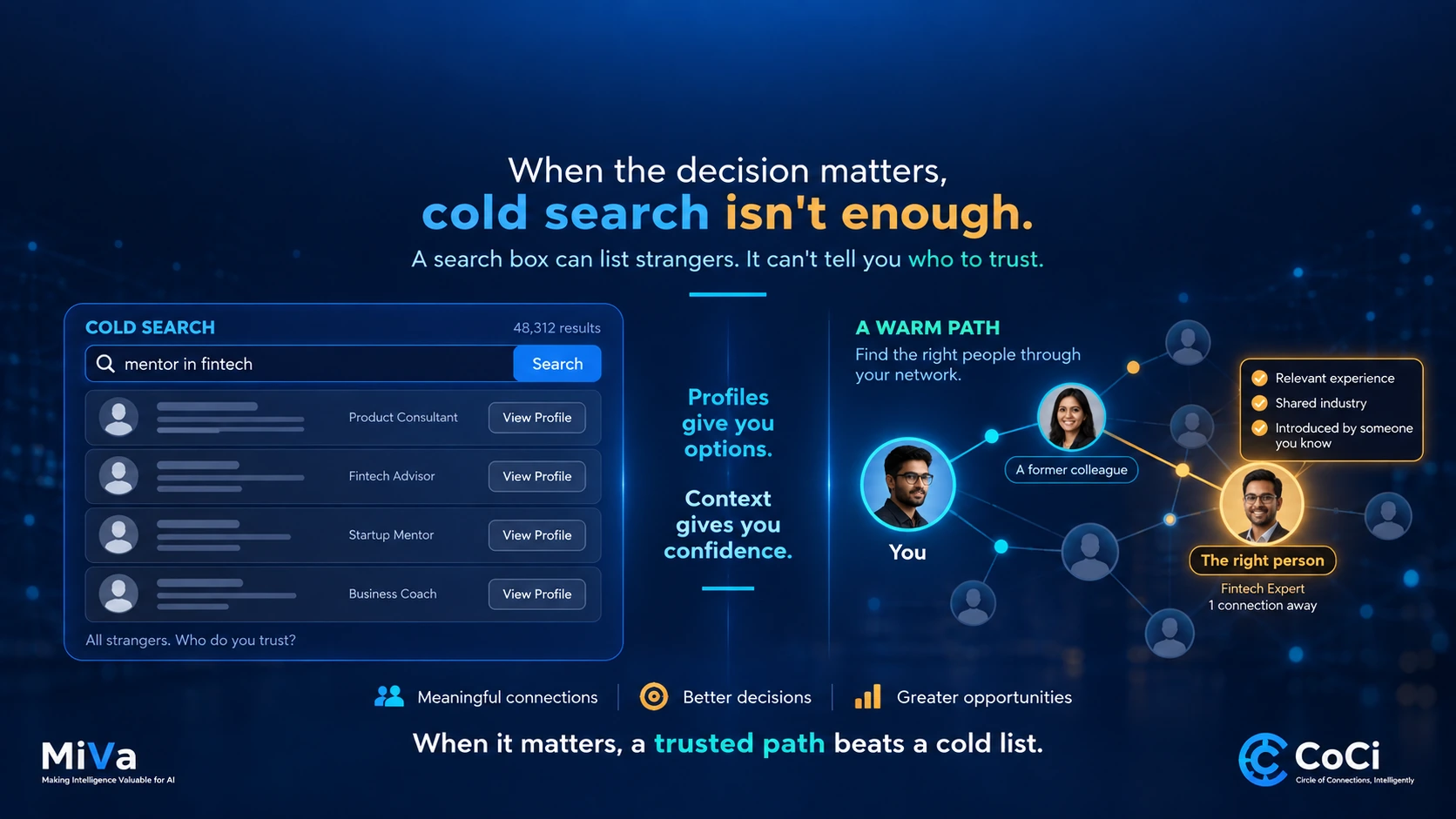
But imagine being able to understand that one of those people is connected to you through someone you already know.
Suddenly, you are not looking at a completely unknown profile.
You are looking at a person with a relationship path.
The path may be direct.
It may pass through someone else.
It may extend through several levels of your wider network.
The important part is that the relationship context becomes part of the discovery experience.
This is one of the ideas behind CoCi
At MiVa AI Systems, we are building CoCi around a simple observation:
People should not always have to start from zero when they need someone.
CoCi explores a different way of thinking about discovery — one that considers not only profiles, but also the relationships around those profiles.
The goal is not simply to show you another list of people.
The goal is to help make the path between people easier to understand.
This matters especially when the situation involves something meaningful: finding a mentor, exploring a career opportunity, looking for professional help, or discovering someone relevant to a business need.
The role of AI should be to reduce the search, not remove the human
As AI becomes better at understanding language, context, and patterns, it can make this kind of discovery much easier.
You should be able to describe what you need in natural language rather than figuring out the perfect search query.
An intelligent system can then help identify potentially relevant people and explain why they may be relevant.
But there is an important principle here:
AI can help you discover a path. It should not manufacture trust for you.
The human relationships still matter.
The context still matters.
Your judgment still matters.
From static identity to living relationships
A digital profile is mostly a snapshot.
Relationships are different.
They change.
They develop.
They gain history.
They create recommendations, experiences, introductions, and opportunities.
That means our digital identity does not have to be limited to a collection of static profile fields.
It can also include the relationships and context that help other people understand where you fit in a network.
This is a much more human way to think about digital trust.
The next generation of networking may be about context
For years, digital networking has focused on building bigger networks.
More contacts.
More followers.
More profiles.
More visibility.
But perhaps the next step is different.
Perhaps the more important question is not:
“How many people can I find?”
but:
“Which people are relevant to me, and why should I consider reaching them?”
That shift—from profiles to context, from search to relationship-aware discovery—is one of the ideas CoCi is exploring.
We do not need fewer profiles. We need more context around them.
Profiles are useful.
Search is useful.
Reviews are useful.
Recommendations are useful.
The challenge is bringing these signals together in a way that helps people make better decisions without pretending that trust can be reduced to one simple metric.
That is the direction we are exploring with CoCi.
Not replacing profiles. Making them more meaningful.
Not replacing relationships. Making the relationships around them easier to understand.
Because when you need the right person, knowing who they are is only the beginning.
Knowing how you are connected to them may be what helps you take the next step.
Explore CoCi and MiVa's products, learn more about our AI and intelligent system solutions, or talk to MiVa AI Systems about building technology around real-world trust and human needs.